A few nights ago I put my phone on a wireless charger and noticed a faint high-pitched warble, almost like the chirp of a dial-up modem. My first thought was that the charger was about to fail. It turns out this sound is almost always normal: the coil and components vibrate slightly under electromagnetic force, and a slice of that vibration lands in the audible range. The takeaway: a working charger that makes a quiet sound is the coil vibrating, not a sign that it is about to break.
The mechanism is straightforward. Wireless charging uses electromagnetic induction: the coil carries alternating current, the ferrite core expands and contracts under magnetostriction, the windings are pulled by Lorentz forces, and the ceramic capacitors flex slightly like piezoelectric elements under changing voltage. Engineers call this "coil whine." A Qi charger's inverter switches near 100 kHz, but its modulation can spill into the audible band, and that is what you hear. The point: coil whine is electromagnetically induced acoustic noise that is hard to eliminate entirely.
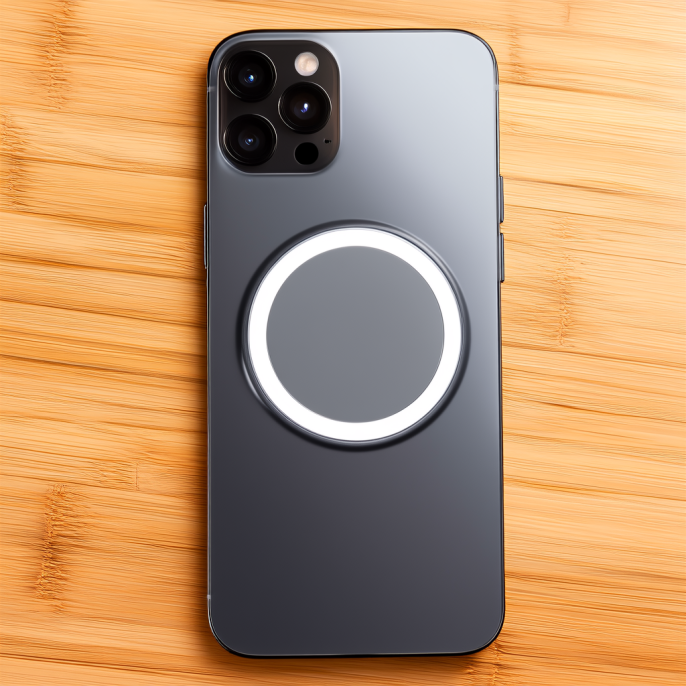
Why is the same pad sometimes louder? The manuals are blunt about it: poor alignment, a weak old adapter, or charging several devices at once all amplify the whine. I confirmed this myself — pressing the phone dead-center on the coil dropped the sound at once, and swapping a five-year-old 5 W brick for a 20 W+ PD adapter made a much bigger difference than I expected. The lesson: centering the phone and using a proper 20 W+ PD adapter usually cuts the whine by more than half.
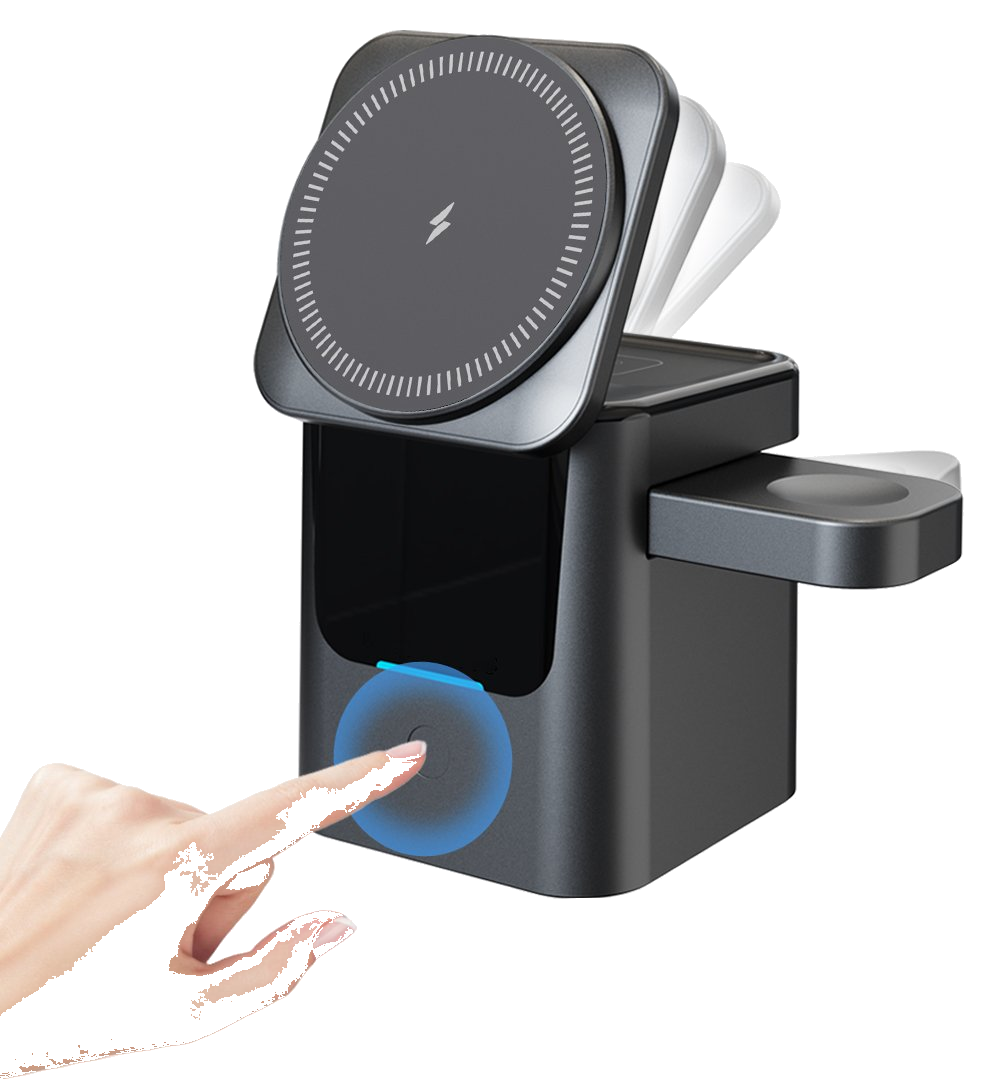
Then there is a different sound entirely: a steady whoosh of airflow. Chargers that sustain 50 W almost always use an active cooling fan. The iQOO 50 W stand spins a 3600 rpm turbo fan and drops to about 27 dB in its night quiet mode; Honor's 50 W stand auto-switches to an ultra-low-noise mode from 21:00 to 07:00; OnePlus AIRVOOC 50 W is rated below 32 dB at 30 cm in standard mode and below 23 dB in silent mode. That whoosh is the price of sustained 50 W, and good units keep it under 30 dB. The conclusion: the whoosh from a 50 W charger is its cooling fan, and well-built models stay under 30 dB.
Telling them apart is easy. Coil whine is a thin, high whine that shifts pitch through the charge cycle and stops the moment you lift the phone. Fan noise is a steady airflow sound found only on high-power active-cooled units. In my home, a slim 15 W magnetic wireless charger that squeals at high pitch is almost certainly the coil; the constant whoosh from a 50 W stand is the fan. The fastest check: lift the phone and see if the sound stops. The rule: sound that stops when you lift the phone is coil whine; a steady whoosh only on 50 W units is the fan.
A few fixes genuinely help. First, center the phone on the coil — on a magnetic charger, let it snap into place. Second, use a real 20 W+ PD adapter instead of an old weak brick. Third, set the charger on a rubber or neoprene mat to stop vibration coupling into the desk; engineering notes recommend exactly this to suppress structure-borne noise. Fourth, for bedside use, pick a model with a night or ultra-low-noise mode. You cannot remove coil whine by firmware, but a mat and good placement cut it noticeably. The summary: a rubber mat, good alignment, a proper adapter, and a night mode are the four most practical ways to quiet a charger.
Some signs do warrant caution. A faint whine with normal charging is fine, but if a thin squeal grows into a loud, dull buzz with rattling, paired with intermittent charging, a housing too hot to touch, or a burning smell, the coil may be loose, a capacitor may be failing, or the unit may simply be worn out. When you get the "loud, hot, and stopping" combination, stop using the old charger and replace it. The line: a quiet whine is normal, but loud, hot, and intermittent charging means it is time for a new charger.
To avoid the annoyance when buying, certify first. Murata's engineering note points out that chargers without noise suppression can be louder and also fail EMC limits in the 30–100 MHz band, degrading phone reception and never passing certification. In practice, certified brand magnetic wireless chargers keep both whine and safety under control; for bedside use, pick one with an ultra-low-noise night mode — sleeping well matters more than saving a few dollars. The conclusion: choose Qi/Qi2 certified chargers, and for the bedside pick one with a night quiet mode; it is both quieter and safer.
This article is originally published by Shanwu. Please credit the source when reposting.
Copyright © 2026 Shanwu. All Rights Reserved.