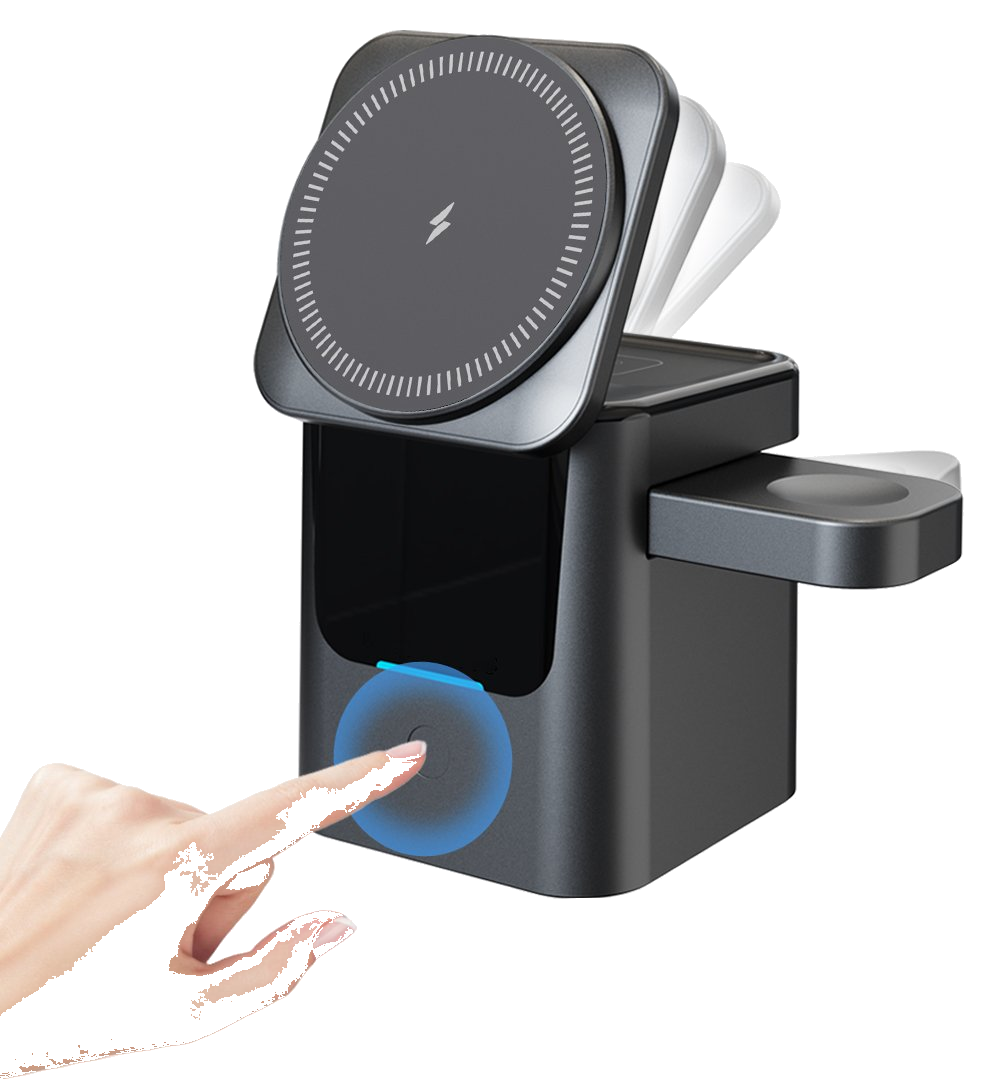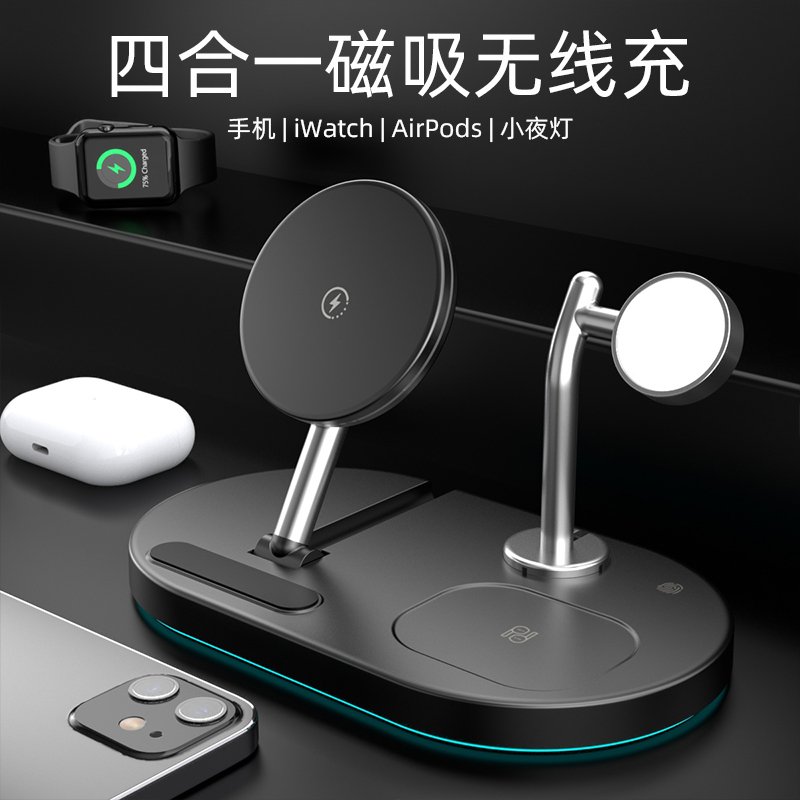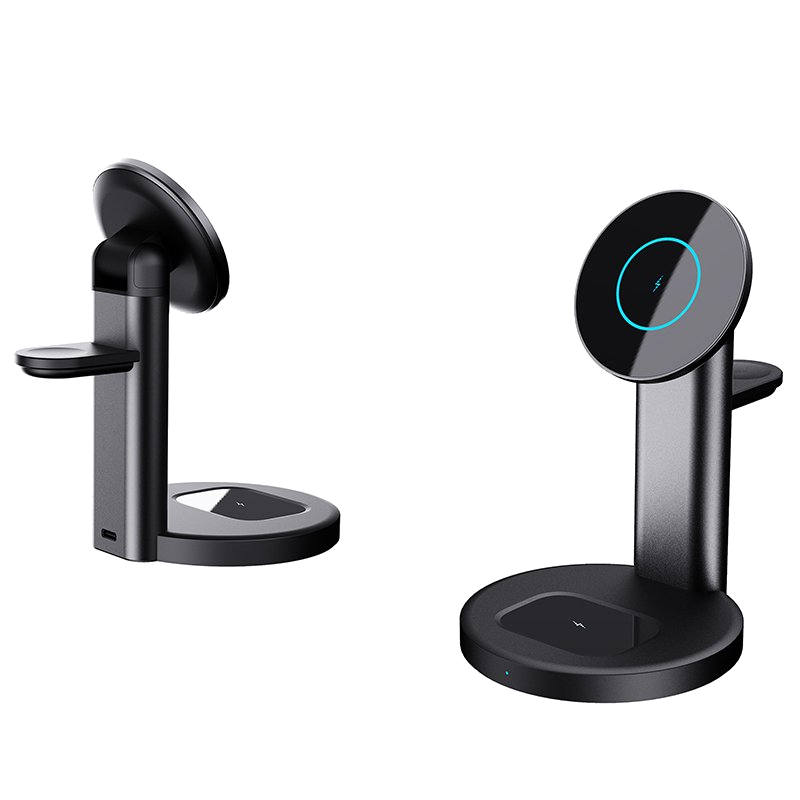
Last month a friend asked me to help pick a magnetic wireless charger. He couldn't believe it: the box clearly said 15W, yet his iPhone gained only about 20% in half an hour. So I strung his adapter, charger, and phone through a POWER-Z meter - and the input side read just over 6 watts. That's when it clicked: the number on the box and the watts actually reaching the phone are two very different things. It's the first trap most people fall into with wireless chargers - treating the 'rated' number as the 'delivered' one.
Tier one is the number printed on the box. The 5W, 7.5W, 15W, 25W, or 50W rating is a 'peak rated power' - not the steady figure you get through an entire charge. The baseline Qi profile caps at 5W, the EPP extension at 15W; Qi2's magnetic MPP mode reaches 15W and Qi2.2 opens it to 25W. That 50W figure, meanwhile, is a phone maker's proprietary protocol, not part of standard Qi. So don't get excited by '15W' - it's just the product's ceiling, not what your phone will actually touch.
Tier two is what the protocol handshake actually allows - the most hidden layer of inflated claims. Apple's own support document (105047) is explicit: on plain Qi, an iPhone is capped at 5W or 7.5W, and you need MagSafe or Qi2 to reach 15W. ChargerLAB's teardowns confirm it - the same iPhone 15, on an MFi-certified magnetic wireless charger, shows about 18.9W at the adapter (minus ~20% loss, a clean 15W into the phone); on an uncertified plain Qi pad, the reading drops to 5.9W. Android is blunter: hitting 25W or 50W requires the maker's proprietary protocol and its original adapter; third-party pads fall back to a few watts of generic Qi. The bottom line: no certification, no protocol match, and that '25W' label behaves like 7.5W.
So how does a normal person find out the real wattage? First, a trap to avoid: don't trust those 'charging power' apps on your phone. Anker's own support page warns that since iOS 10, the system no longer shares battery details with third-party apps, so their readings are rough estimates at best. The reliable method is to put a USB tester like POWER-Z between the adapter and the charger and read the 'input power.' Rule of thumb: efficiency is about 80%, so an input of 18 to 19W means roughly 15W into the phone, while about 9W corresponds to roughly 7.5W. Keep that formula in your head and you can see through any label at a glance.
Tier three is the easiest to miss: even if the protocol tops out, heat takes another cut. Wireless charging turns 15% to 25% of its energy into warmth, and once the phone's back crosses 38°C, the system throttles power to protect the battery. In ChargerLAB's test, the official MagSafe ran full for the first 10 minutes, then locked to 10W or even 5W the moment the back hit 38°C - an hour of charging for just 20%. A magnetic charger with active semiconductor cooling told a different story: the same iPhone Air went from 29% to 72% in 30 minutes, back panel held around 30°C, no throttling at all. So that '25W' label usually loses another slice to thermal control, and what you actually feel may be only two-thirds of it.
One more myth, this time about multi-device wireless charging. Many people see '15W' on a 3-in-1 wireless charger and assume the phone, watch, and earbuds each get 15W. The reality isn't additive - in ChargerLAB's test, Belkin's Qi2 2-in-1 charging an iPhone and AirPods together drew only 20W total, with the phone getting just 6.77W and the earbuds a bit over 2W. That 15W is the ceiling when a single device has the coil to itself; split three ways, the total power is shared. If you buy a multi-device wireless charger expecting every device to charge fast at once, you'll likely be disappointed.
For buying, here's a checklist you can use right away: - To hit top speed, first confirm which protocol your phone supports (Qi2 or MagSafe for iPhone, the maker's proprietary one for Android), then buy a certified magnetic wireless charger to match - don't just chase the watt number. - Once it arrives, test the input side with a POWER-Z: about 18 to 19W means 15W, about 9W means 7.5W; a big gap is inflated labeling. - In summer or while using the phone, prefer a model with cooling (fan or semiconductor) so thermal throttling doesn't kill the speed. - For multi-device models, ask whether the 15W is 'per device' or 'total' before you buy. Remember these and no flashy label can fool you.
A word to the people who build wireless chargers. Inflated wattage hurts the whole category's reputation - one bad experience and the user only trusts the original brand next time. Responsible design and customization means putting the 'real sustainable power' in the spec, not selling the instantaneous peak. In manufacturing and sales, sample-test every unit with a power meter before shipping, and for bulk deployments in public spaces, write 'idle power limit' and 'FOD foreign-object detection' into the acceptance contract. Show the real numbers and users will trust wireless charging on their desk, bedside, and car.
This article is originally published by Shanwu. Please credit the source when reposting.
Copyright © 2026 Shanwu. All Rights Reserved.