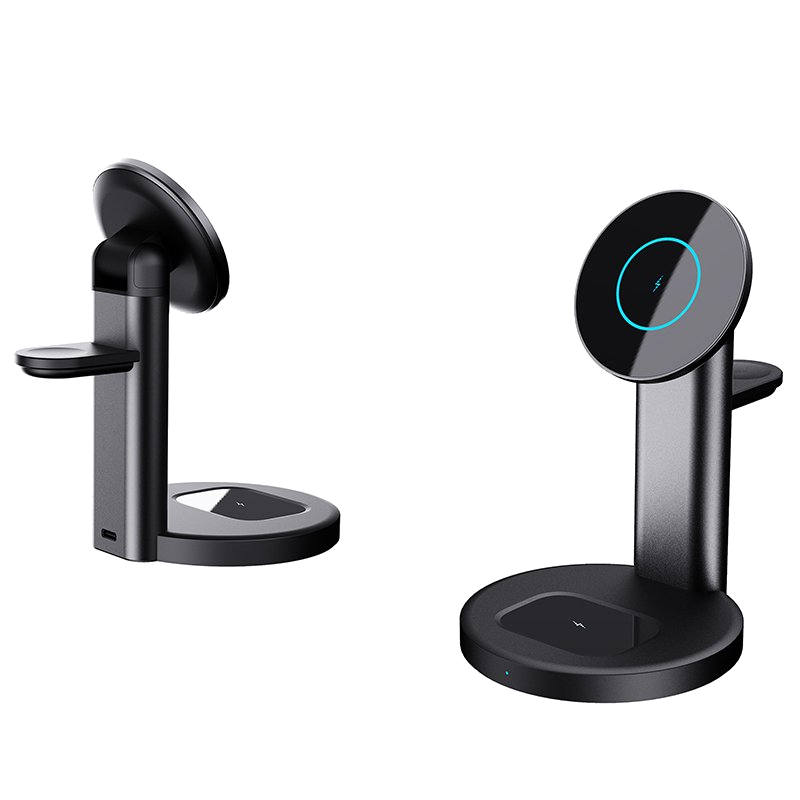
The magnetic wireless charger in my car has been running since last winter, through daily commutes and a stretch of ride-hailing shifts. I started cheap—a no-name unit for the price of a couple lunches—and returned it within two weeks. Only after switching to a proper one did I figure out how these things actually behave. Here's the takeaway up front: a car magnetic wireless charger really is convenient. You get in, the phone snaps on, it charges, and navigation and calls no longer tie up your hands. But the price gap between junk and the real thing goes entirely into what you can't see—magnets, cooling, and power delivery. None of it is where you should cut corners.
The first thing that turns people off is always the phone not staying put. There are two main types: a clip that grabs an air-vent blade, and a pad you stick to the dash. Vent mounts install easily and stay quiet on smooth roads, but they can loosen on sharp turns and speed bumps. Adhesive mounts are steadier—provided the 3M pad isn't the cheap kind that peels off after a hot day in the sun. On magnets, iPhone 12 and later have a built-in ring, so it lands with a satisfying click; most Android phones need a stick-on metal ring. Don't chase the cheapest option with inflated magnet claims—a proper unit uses N52-grade neodymium, and the phone shouldn't budge on a bumpy road.
The phone case is a silent killer that has burned plenty of people. Forget metal cases entirely—magnets can't reach through them. A thick case with an embedded plate, or any hard shell over 1.5mm, throws off Qi2 alignment, so you get anything from an off-center fit to charging that keeps cutting in and out. The safest bet is a thin silicone case or a purpose-built magnetic one. One overlooked detail: never stick the metal ring over the camera or the wireless-charging coil area—a few millimeters off and charging drops in and out. The self-check is dead simple: set the phone on, give it three gentle shakes, and if it doesn't shift, the fit is good.
The "it charges slower and slower" complaint deserves a proper explanation. 15W Qi2 is basically the entry bar now—stop buying 5W relics. But understand that 15W is the peak, not the whole session. I dug up a bench test from a charging-hardware site on a mainstream unit: an iPhone 14 Pro in a 25°C chamber hit around 12W for the first 16 minutes, then settled to 7–9W, taking 2 hours 16 minutes to fill. In a car it's only slower—navigation keeps the screen lit, the cabin runs hot, and the charger throttles down. So don't measure it against wired fast charging. Topping up 20–30% on the drive so you step out without range anxiety is what it's actually for.
Summer is the great revealer. A sun-baked cabin can hit 50–60°C, and a wireless charger already generates heat from its own losses; stack the two and cheap units demagnetize, unstick, or even warp on the spot. That's why active cooling has caught on these past couple of years: budget units rely on an aluminum body for passive dissipation, while the serious ones add a fan or even a semiconductor cooling plate. I've seen bench numbers on one gaming-brand unit holding a phone near 25°C inside a 40°C cabin. There's a low-tech way to judge real cooling—touch the back while it's charging; noticeably cold means genuine cooling, merely warm is usually marketing. The semiconductor plate itself draws 1.8–2.3W, which for summer drivers I think is worth it.
There's another pitfall almost nobody mentions, yet it takes the blame most often: the car charging head. To hit a full 15W or more, a magnetic wireless charger needs a head that supports PD/QC fast-charging protocols. Plenty of people plug into an old 5V/2A socket, get low-power trickle charging the whole way, and blame the charger's quality—unfairly. EV owners should be extra careful: many cars supply power over USB-C natively, and you have to confirm the protocol matches, or you'll either never top off or trip a protection cutoff. Before buying, check exactly what that port in your car can actually deliver.
A word on safety while we're at placement: don't mount it dead center on the windshield, and never on the passenger airbag cover—both are real hazards, and traffic police will flag them. The steadiest spots are beside the center screen or off to the side of a vent, low and out of your main line of sight. Genuinely avoid no-name units: heat demagnetization, inflated magnet ratings, and no over-charge or over-voltage protection—bad for the phone and unsafe. Look for proper certification before you buy. By use case: for city commuting, a basic 15W vent mount is plenty; for long hauls or ride-hailing, go strong-magnet adhesive with active cooling; iPhone users should grab a MagSafe magnetic model and skip the stick-on ring.
In the end, there's no single "perfect" car magnetic wireless charger—only one that fits how you drive. Don't let the spec sheet lead you around; think first about how you actually spend those minutes in the car each day—short city hops, or long highway runs with frequent stops. Once that's clear, most of the pitfalls above are easy to sidestep. The wireless charger business is fiercely competitive now, with everyone fighting over the details from design customization to production and sales. That's exactly why it's worth putting in the effort to choose well—so you don't hand a good experience over to a no-name unit that quits on you in summer.
This article is originally published by Shanwu. Please credit the source when reposting.
Copyright © 2026 Shanwu. All Rights Reserved.