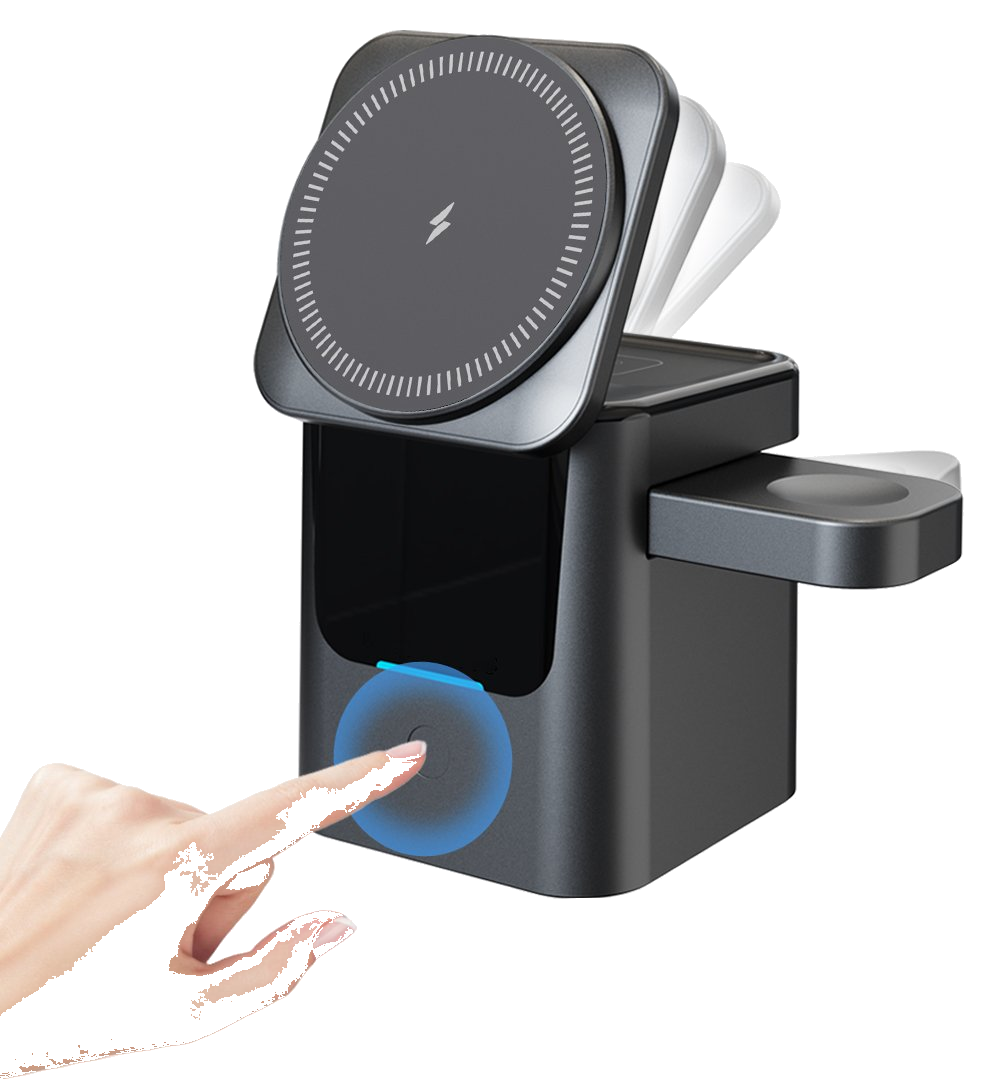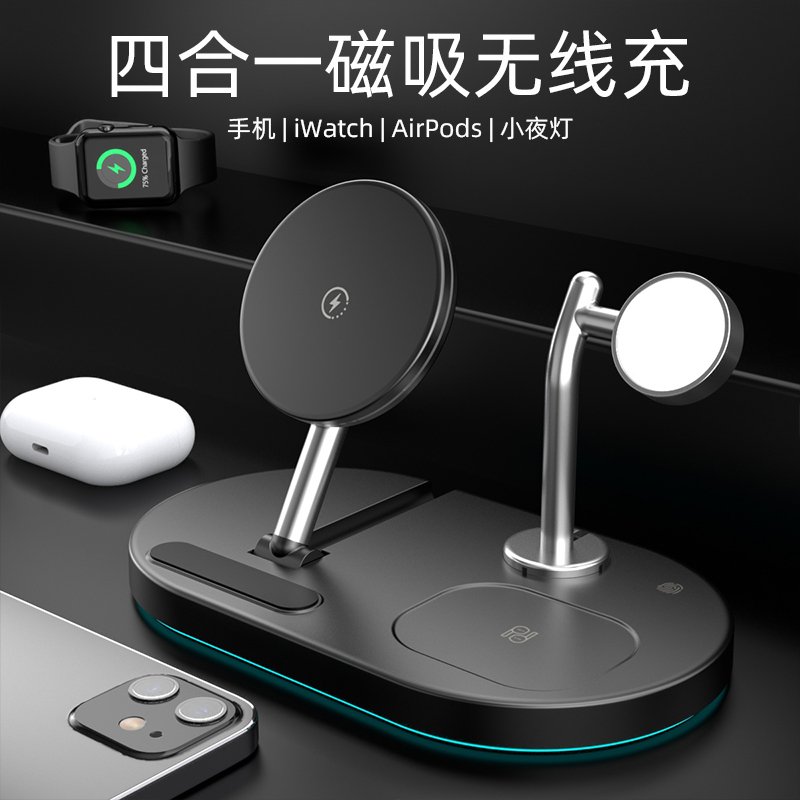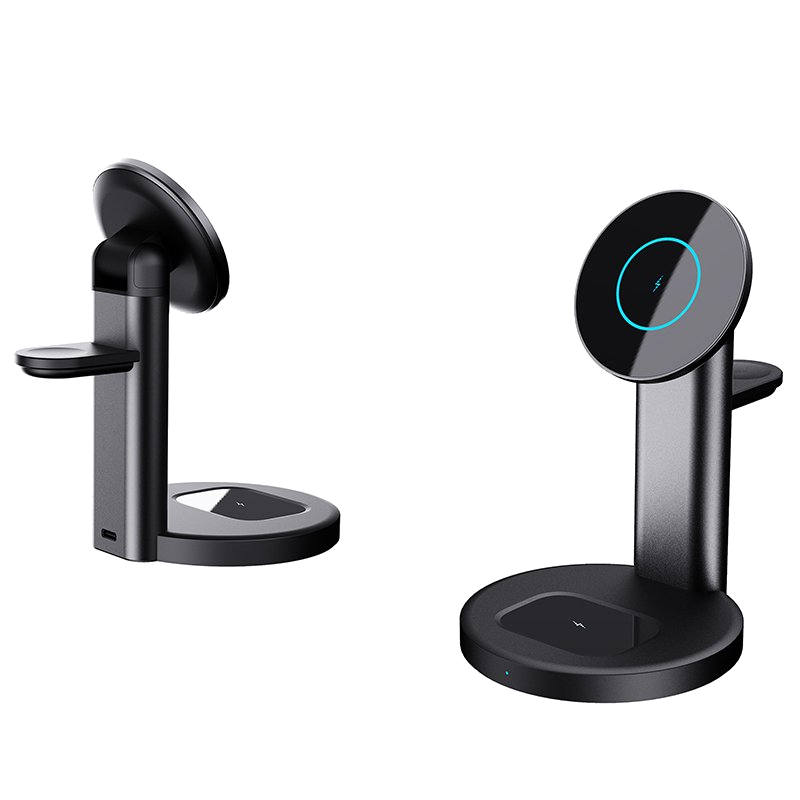
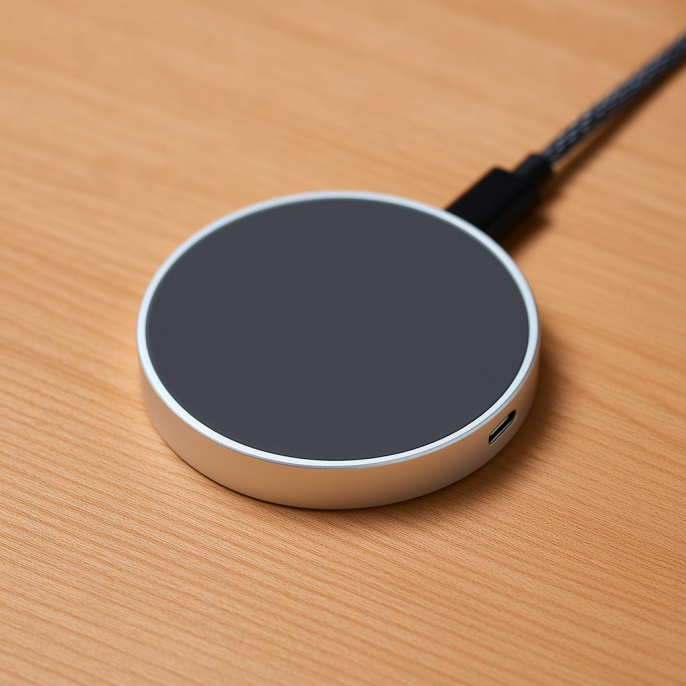
Shopping for a magnetic wireless charger is easy to get fooled by the spec sheet. Two round pads that look nearly identical—one priced at thirty or forty, the other at nine-ninety—can differ wildly in charging speed, heat, and how they hold up after two years. I tore open a few units across price tiers and realized the gap isn't in the shell at all; it's entirely in what sits inside.
At the heart are two parts: the charging coil and the ferrite sheet glued to its back. The coil is usually wound from litz wire and turns electricity into an alternating magnetic field; the ferrite—typically manganese-zinc—channels that field to the coil side, boosting efficiency while blocking the leakage that would disturb NFC and bank cards. Better units use grain-oriented MnZn ferrite at least 0.3 mm thick; cheap ones use a film so thin you can see light through it, or skip it entirely, which means low efficiency, interference with phone signals, and a charger that stops the moment the phone is slightly off-center.
The coil count decides the sweet spot. A single-coil pad demands the phone sit dead center over the coil; a few millimeters off and it throttles or drops the connection. Three-to-five overlapping coils hold full power with up to ±15 mm of lateral misalignment, and magnetic models add a ring of neodymium to snap the phone into coaxial position. The nine-ninety pads are almost always single-coil, which is exactly why they feel like they never quite catch.
Above the coil sits the control IC—the charger's brain. It does three jobs: negotiates power with the phone through in-band signaling over the coil, runs foreign-object detection (FOD), and watches temperature. Apple's MagSafe pairs a STMicroelectronics STM32F4 with a custom wireless-charging controller plus a TI temperature sensor; Huawei's 80W stand uses a ConvenientPower controller with dual coils and a fan. Cheap units either use unbranded public-board dies or drop FOD altogether.
FOD deserves its own mention. When metal like keys or coins lands on the pad, the alternating field induces current in it and heats it fast—at best too hot to touch, at worst it scorches the case. Certified pads use both power-loss and frequency-shift methods to spot and cut power within milliseconds; uncertified boards often only shut down once temperature spikes dangerously high, leaving a coin hot enough to cook on. Looking for the Qi or Qi2 mark beats trusting the wattage label by a wide margin.
Heat is the unavoidable wall—efficiency tops out around 70%, and the missing ~30% becomes warmth. That's why mid-to-high-end units add cooling: graphite sheets, aluminum plates, or even a small fan like Huawei's 80W and Xiaomi's car mount. The measured numbers tell the story: at 15W for ten minutes, an unbranded pad's coil surface hit 62°C and forced the iPhone down to roughly 2W, while a GaN-equipped mid-tier Qi2 pad stayed near 38°C and held above 12W, and Apple's MagSafe Duo ran about 34°C. The difference is those few thermal parts.
Breaking down the cost makes it clearer. The main control chip runs one or two yuan for a public-board die but five to ten for a branded Qi IC; the coil alone—single thin copper with no shielding versus thick litz multi-coil with nanocrystalline ferrite—can differ by several yuan; the shell, recycled thin plastic versus fire-rated ABS/PC thick housing, feels and endures completely differently; then add Qi2, CE, FCC, ROHS certifications, which split out to several or even a dozen-plus yuan per unit. The nine-ninety free-shipping pad usually picks the lowest option on every line.
You don't need to actually open one up, but a few hard rules keep you safe: look for the Qi or Qi2 mark and a verifiable certification number rather than trusting the word compatible; for magnetic models, prefer ones that state suction force and thickness instead of vague super-strong magnet claims; check whether the nameplate lists standby power and thermal control; and if the price is absurdly low, assume the savings came from the coil, FOD, cooling, and certifications. Buying right once beats replacing a pad every six months.
This article is originally published by Shanwu. Please credit the source when reposting.
Copyright © 2026 Shanwu. All Rights Reserved.