
The iPhone 18 Pro and Pro Max went on sale on September 18, and the accessory market has arguably changed more in the past week than the phone itself. The clearest split is in magnetic power banks: the same slab of battery stuck to the back of a phone, but this year's models have moved to two opposite ends on thickness.
One path goes thin. Baseus's new Picogo Air measures just 0.27 inches thick and weighs 3.7 ounces, holds 5,000mAh, tops out at 7.5W wirelessly and delivers 22.5W over a cable. In China, a 6mm ultra-slim magnetic power bank from MOMAX comes in at 112 grams and 5,000mAh with 22.5W wired output for 323 yuan, and it ships in a burgundy finish matched to the iPhone 18 Pro's new body colour. What this camp sells is not speed but the feeling of barely noticing it is attached.
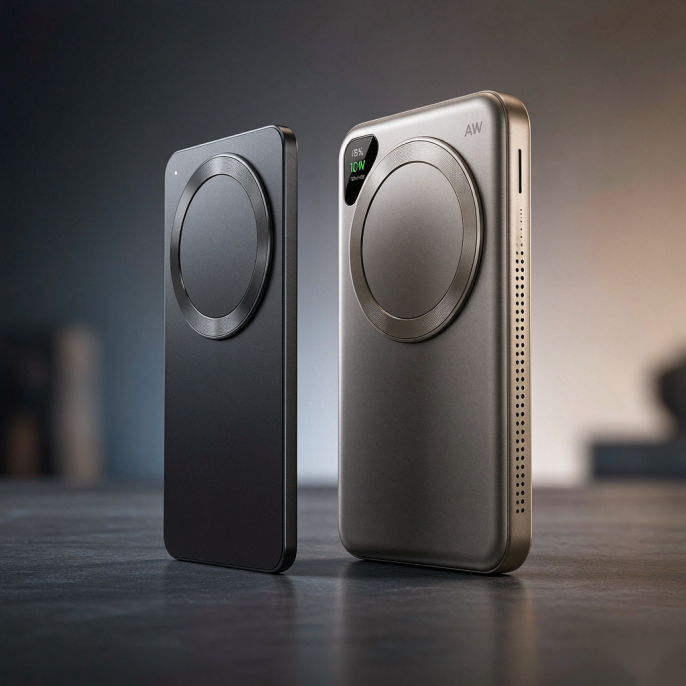
The other path goes the opposite way. Anker's MagGo 2 Pro pairs a 10,000mAh battery with Qi2.2 wireless charging at 25W, squeezes a SnapCool fan inside for heat control, adds a smart display on the front and an adjustable kickstand on the back, recharges itself over USB-C at 45W and, by Anker's claim, gets back to 80% in under an hour, all for 109.99 dollars. UGREEN's MagFlow takes the same route with 10,000mAh, 25W wireless plus 45W wired and a micro-pump liquid cooling loop, priced at 99.99 dollars. This camp's idea is to merge power bank, stand, display and cooling into one object.
That divide is not a matter of taste; it is forced by power. Once Qi2.2 lifted the ceiling on magnetic wireless charging from 15W to 25W, a 5mm to 6mm body could no longer shed the heat, leaving two exits: drop the wireless rate and lean on 22.5W over a cable to keep the slimmest shape, or add thickness, a fan and liquid cooling to chase the highest speed. Magnetic power banks used to be a contest of who was thinner; this year the question comes first: what are you actually using it for?
Colour is the other underrated line this year. The iPhone 18 Pro ships in black, silver, glacier and burgundy, and the burgundy finish has drawn the most chatter online, with accessory makers following fast. Anker's MagGo 2 Pro comes in burgundy red, phantom grey, polar night blue and starlight silver; Baseus launched a 25W Qi2.2 magnetic power bank at 66 dollars in the same family of finishes; Satechi is pushing colour-matched 240W braided USB-C cables. Matching the phone used to be a case-only affair; it now extends to power banks, cables and car chargers, which means colour management has moved from the styling department into product definition itself, a real consideration for anyone doing design and customization.
Zoom out and the volume behind this cycle is not small. Industry analyses broadly put the accessory increment at 8 to 12 billion dollars, driven mainly by folding designs: protective cases built for a folding body can be priced at 45 to 85 dollars, far above the 15 to 25 dollars typical of a conventional phone shell, while the wireless charging category usually grows 40% to 60% in the 30 to 45 day window after a new phone lands. In other words, accessory replacement no longer follows the month a phone is refreshed; shifting form factors pull it forward.
Back to picking one, the real trade-off usually shows up the moment it goes on the phone. A 10,000mAh do-it-all unit with a fan and metal structure generally tips past 200 grams, and holding the phone one-handed to scroll feels noticeably heavier; a 5,000mAh slim pack stays between 105 and 112 grams for something close to weightless, at the cost of 7.5W wireless and not much of a top-up in a day. One adds a brick to the phone, the other adds a few sips of power; which one you want depends on whether you carry a cable every day.
Put together, the real substance of this split is that Qi2.2 turned magnetic attachment from a way of lining coils up into a power standard with a clear threshold. Doing business in this segment in the second half of 2026 comes down to roughly three things: whether the 25W certification is genuine, whether the cooling design can hold full power for long sessions, and whether colour matching can be reproduced consistently at volume. Form factors keep raising the stakes, and this accessory replacement cycle will not end when the phone's launch month does.
This article is originally published by Shanwu. Please credit the source when reposting.
Copyright © 2026 Shanwu. All Rights Reserved.