I was browsing the WPC certification database compiled by ChargerLAB recently and one number caught me off guard: as of their latest tally, Qi2 and Qi2.2 certified products combined have reached 3,334, spread across 13 product categories. Three years ago, when people talked about wireless charging, what came to mind was basically a pad stuck to a phone. Open the certification list today and you'll find phone cases, earbuds, speakers, power strips, lamps and even makeup mirrors carrying the Qi logo. Wireless charging is quietly shifting from a phone accessory into a general capability buried inside all kinds of everyday objects.
Break down those 3,334 products and the usual suspects still dominate, but the scale is in a different league now. Multi-device chargers — the kind that feed a phone, a watch and earbuds at once — lead with 1,018 models; magnetic wireless power banks follow with 786; car chargers and desktop pads each run into the several hundreds. What I find more interesting is the long tail of "non-typical" categories: phone cases, power strips, lamps, makeup mirrors. Each is small on its own, but together they tell a story — whenever a product can fit a coil, makers are now seriously shipping an electrified version of it.
Why now? The answer isn't wattage, it's magnetic alignment, finally solved by Qi2's Magnetic Power Profile. The most annoying thing about old wireless chargers was misalignment — put the phone down slightly off and it wouldn't charge, forcing users to nudge it back and forth. Magnets snap the device right above the coil, so alignment no longer depends on feel. Once alignment becomes the default experience, cross-brand interoperability turns into a reasonable expectation: one charging surface serves an iPhone, a Galaxy and a Pixel instead of three incompatible pads. With the standard unified, what makers compete on shifts too — peak power is locked by the spec, so the real differences show up in sustained thermal behaviour, build quality and industrial design.
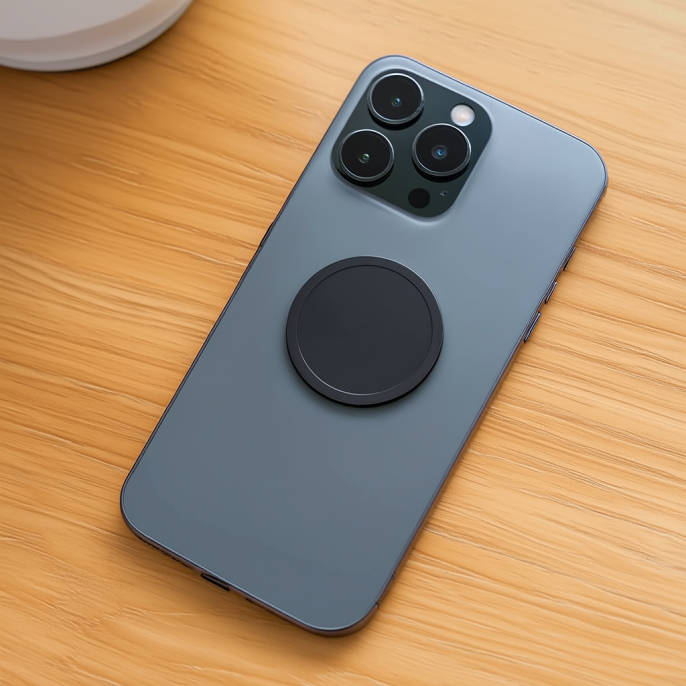
For hardware makers this is a subtle signal. The barrier is actually dropping: pre-certified turnkey modules and mature ODM platforms let a small team ship a compliant magnetic charger fairly quickly. On the flip side, when every certified product charges at roughly the same speed, the game moves to who keeps the heat silent, who builds a magnet array that still holds a cased phone, and whose tooling and looks wear better over time. In other words, wireless charging is shifting from "spec competition" to "design and customization" — and that is exactly where smaller manufacturers can still tell a differentiated story.
From the user's side, the most visible change is that multi-device charging stations have become the default on desks and nightstands. The fact that tri-chargers and multi-function pads reached a four-figure scale comes down to one fixed habit: a phone, a watch and earbuds charging together overnight, all full by morning. Rather than a tangle of cables on everyone's desk, a magnetic station folds the mess into a single pad. The same technology is steadily seeping into home and in-car scenarios too — from magnetic car mounts to charging modules embedded under café tables — nudging wireless charging toward the "invisible top-up" everyone keeps talking about.
Stretch the timeline and the next turning point is already on the roadmap. Qi2.2 pushed the ceiling to 25W, and the 50W tier (the Qi2.3 direction) is targeted for commercial use around 2027; at the same time even the bundled adapter is now governed by new efficiency standards that push standby draw down to the milliwatt level. When a feature degrades from a standalone product into just another trait inside a product, the focus of competition stops being "can it charge" and becomes "does it charge steadily, quietly and efficiently." For the industry that isn't necessarily bad — it means wireless charging has truly become infrastructure.
This article is originally published by Shanwu. Please credit the source when reposting.
Copyright © 2026 Shanwu. All Rights Reserved.