
The same iPhone 17 can reach roughly 50% in half an hour on a MagSafe pad in Hong Kong, yet the mainland China edition never climbs past 15W. Apple isn't shortchanging Chinese buyers and the hardware is identical — the gap comes from a radio-frequency rule most people never read.
In September 2024, China's Ministry of Industry and Information Technology put its radio management rule for wireless power transfer into effect. It restricts portable chargers to three narrow frequency windows, and the 360 kHz band that Qi2's magnetic alignment relies on lands squarely inside the aviation radio-navigation range, so it is outlawed. The upshot: even when a phone is built for 25W magnetic wireless charging, the China edition is software-capped at 15W, the same ceiling as the older Qi2.
In practice, Apple's China site lists the MagSafe ceiling for the iPhone 17 family at 15W, with the iPhone 17 Air a touch higher at 20W, while a plain Qi pad delivers only 7.5W. Overseas models paired with a third-party Qi2.2 charger reach the full 25W. The saving grace is compatibility: your magnetic wireless charger still works on a China-edition phone, the two sides simply meet at the 15W step and neither can climb higher.
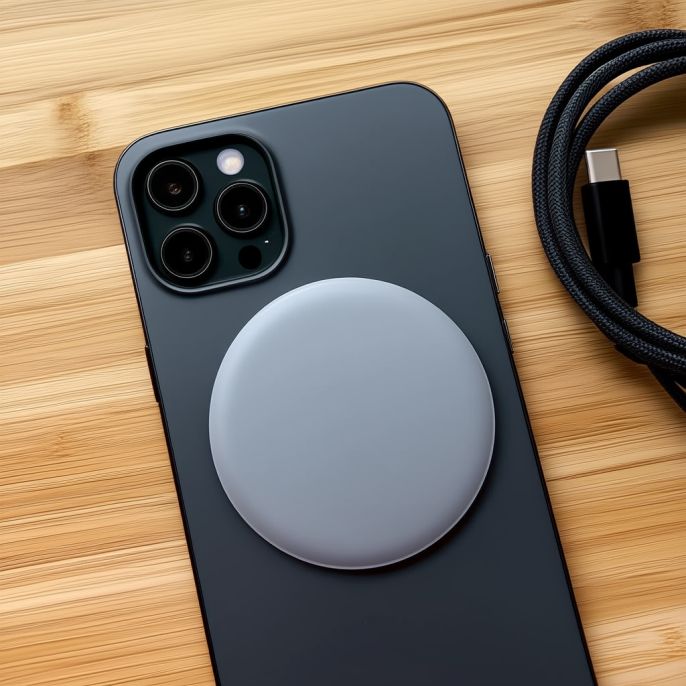
The more interesting reaction came from Chinese brands. Blocked from the 360 kHz band, they largely skipped Qi2 and built their own high-power wireless charging instead — Xiaomi and OPPO have shipped 50W and even 80W wireless charging for a while, and Red Magic reaches 80W too. The cost is fragmentation: every vendor runs its own protocol and cross-brand charging mostly fails. So while overseas users wait for one universal 25W, domestic users already have faster but incompatible private standards.
Looking ahead, the WPC is pushing a 50W wireless charging standard, targeted for around 2028, that would pull tablets and slim laptops into the wireless fold. The catch is that the new spec still has to clear the frequency hurdle — unless it can avoid the aviation band entirely, China's two-track system won't simply vanish. For makers of wireless chargers and magnetic pads, the situation has forced a practical lesson: one board needs two parameter sets for export and domestic models alike, and compliance has to be built into design, customization, and the whole production and sales chain.
At bottom, the 15W China cap is a regulatory line, not a technological ceiling. For everyday users the smarter move is to match the charger to the moment: for drop-and-go convenience and a single station that feeds multiple devices wirelessly, 15W with magnetic alignment already feels smooth, while a cable still wins when you are in a hurry. The real thing to watch is whether a future domestic standard can dodge the aviation band while keeping both high power and universal compatibility — that is when the two tracks finally merge.
This article is originally published by Shanwu. Please credit the source when reposting.
Copyright © 2026 Shanwu. All Rights Reserved.