
My 3-in-1 pad has sat on my desk for over half a year, and the biggest puzzle was never that it failed to charge, but that the phone seemed to slow down once I dropped the watch and earbuds on too. After testing with a POWER-Z meter and a few devices, I finally understood that a 3-in-1's power is nothing like simply adding the three numbers together.
Start with the spec sheet. Most 3-in-1 pads follow a phone 15W plus watch 5W plus earbuds 5W layout. The Anker MagGo 3-in-1 (A25M1/A2557) totals 25W, UGREEN W707 is also 25W, and Mcdodo's Qi2 model is rated 22.5W. The phone number is the eye-catching one, so it feels natural to assume the phone takes 15W while the other two take 5W each.
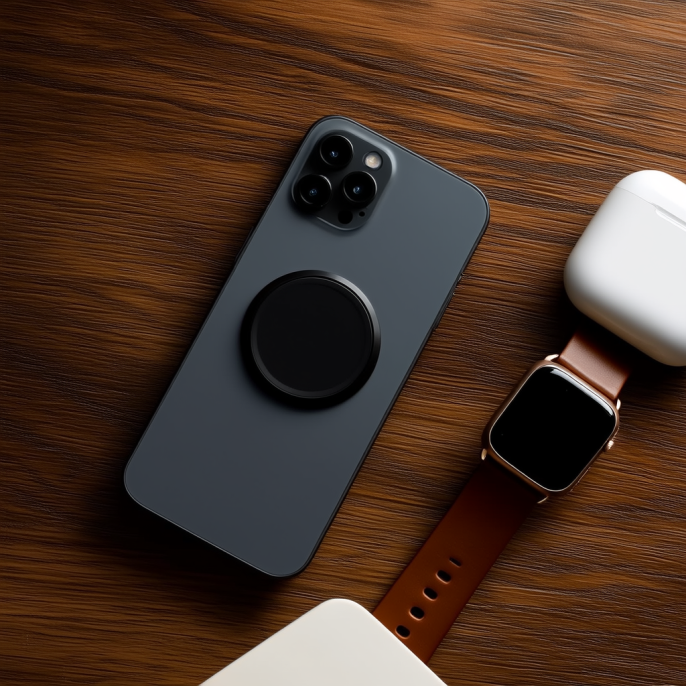
But that spec carries a big asterisk: it is the peak under a single device or ideal cooling, not the steady state when all three sit together. Chongdiantou tested Mcdodo's pad with the full Apple trio. It pulled about 19W at the input charging the phone alone, and 22.73W at the input with all three, basically hitting its 22.5W ceiling. Note this is the input side, not the 15W at the phone's coil. To keep the phone at full speed, the adapter needs real headroom.
The real surprise is heat. Samsung's Trio (EP-N6100) was lab-tested across 48 cycles. In the first 4 to 6 minutes after placement it delivered about 14.2W to the phone, 4.7W to the watch and 3.9W to the earbuds, which looks great. But a few minutes later the thermistors on the PCB triggered dynamic power redistribution and the phone dropped to 9W. The 30-minute average total was only 16.8W, well short of the rated 24.5W. The reason is simple: most 3-in-1 pads use ordinary silicon MOSFETs at about 78 percent efficiency, the rest becomes heat trapped in the body, and once it warms up the current gets capped.
So there are two reasons the phone slows down. First, total power is capped by the adapter, so with three devices the phone's share inevitably gets squeezed. Second, temperature. Chongdiantou measured Anker 737 at about 21.2W input with the full trio and UGREEN W707 at about 22.02W, both below the rated 25W. That gap is mostly efficiency loss and thermal headroom. The 15W you see usually only appears when the phone charges alone, and only in the first few minutes after you set it down.
For everyday users, the most practical takeaway is this: do not expect a 3-in-1 to fast-charge your phone at full speed while also topping up the watch and earbuds. If phone charging speed matters most, charge the watch and buds first and let the phone take the full 15W later, before bed or before you head out. If you would rather wake up to all three full, accept that the phone's tier will be slower and the total time stretches to around 3 hours. Mcdodo's test put a full iPhone 15 Pro charge at about 3 hours 14 minutes.
There are also tricks in buying and placement. Do not cheap out on the adapter. A pad rated 25W usually ships with a 30W to 40W brick. Anker bundles 40W. If you swap in an 18W one, three devices at once will immediately starve it. For placement, keep the phone centered and avoid thick cases. Anker explicitly says stay under 2.5mm. Let the watch and earbuds sit in their own spots and do not stack them, or the coils fight for the magnetic field and you get slower charging or no recognition at all.
In one line: the value of a 3-in-1 was never every device at full speed, but one cable feeding three things while the desk stays tidy. Set your power expectations right, and the fact that it quietly tops up phone, watch and earbuds every day is far more real than the watts on the box. Let go of the urge to fast-charge the phone alone, and a 3-in-1 just works.
This article is originally published by Shanwu. Please credit the source when reposting.
Copyright © 2026 Shanwu. All Rights Reserved.