
Last month a friend asked me along to help pick a phone, and the model he liked had no built-in magnets — the salesperson casually mentioned he'd need a special case for magnetic features. Back home I checked my own Android and found the same situation: I wanted a magnetic wireless charger and a magnetic car mount, but the back of the phone had no magnets at all. I eventually spent a little over twenty yuan on a magnetic ring sticker, and that finally sorted things out.
A magnetic ring is basically a thin circle of neodymium magnets, wrapped in a plastic or metal housing, with 3M double-sided tape on the back and a diameter of about 56 mm. Its job is simple: turn a phone without magnets into one that a magnetic wireless charger or mount can recognize and hold. Baseus sells a two-pack for around 25 yuan, with over 80,000 reviews on JD.com at 4.3 stars — one of the most proven options in this category. For anyone who doesn't want to swap cases, it's the cheapest magnetic fix.
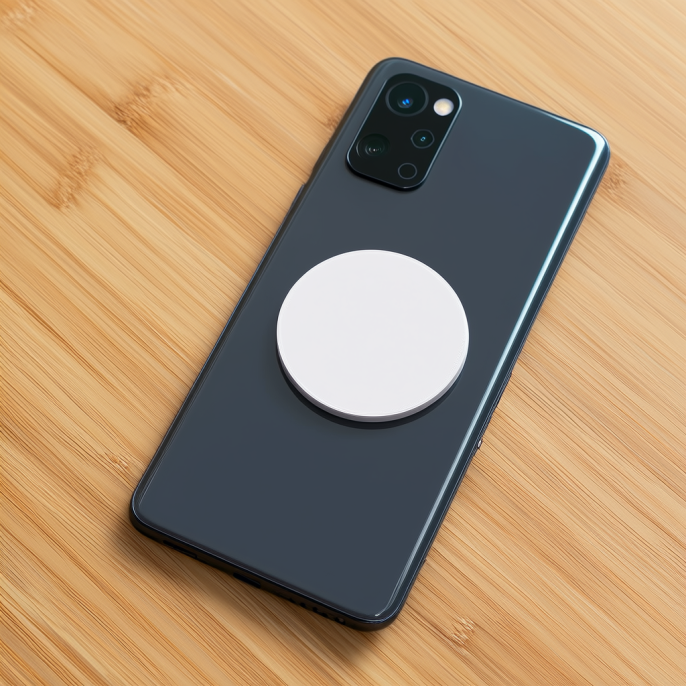
The easiest way to mess this up is poor alignment. The ring has to sit directly over the phone's wireless charging coil; off by a few millimeters and charging slows, heats up, or cuts in and out. The first time I stuck one on by eye, the phone kept sliding to one side on the magnetic pad and the measured power dropped sharply. Then I used the alignment card from the package, taped the ring in place temporarily, connected a charger to confirm a stable hold, and only then peeled the backing — that got it centered. Alignment is the one step you can't skip.
Thinner isn't always better, but too thick is always a problem. Rings commonly come in 0.55 to 1.2 mm, and those fractions of a millimeter leave a gap between the phone and the pad. On phones like the iPhone where the coil sits off-center, a bigger gap means a weak hold and flat pads may not charge at all; most Android coils are centered, so the effect is smaller. My take: sticking the ring inside the case is more stable and less noticeable than sticking it on the bare back and then covering it. To keep wireless charging efficient, a thin ring in the right spot is what matters.
Heat deserves its own note. A metal-housed ring has no magnets of its own but can trap heat on some pads; plastic-housed rings with built-in magnets hold more steadily and actually run cooler while charging. I tried one during navigation with charging on, and the plastic version stayed noticeably cooler than the metal-plate version. And the usual rule still applies: don't charge under a pillow or blanket, and avoid leaving it stuck on a sun-baked car dashboard for long — heat is the real enemy of wireless charging.
The adhesive is a landmine many people miss. Proper brands use 3M VHB; after sticking you should press for 30 to 60 seconds and then leave it undisturbed for a few hours so the glue fully cures before hanging a car mount or magnetic case on it. I was impatient, skipped the cure time, and the ring nearly fell off on the mount. Silicone, textured leather, and oily surfaces all bond poorly — wiping with alcohol first is the safe move. Cheap no-name glue is worse: when you peel it off, the residue can ruin the case surface.
There's also the expectation to manage. A magnetic ring fixes 'it holds and it aligns,' not 'it charges fast.' Most Android phones on a MagSafe-style puck actually fall back to ordinary Qi speeds of 5 to 7.5 W rather than Apple's rated 15 W. Overnight trickle charging is perfectly fine; when you're in a hurry, a cable is always faster than wireless. Treat the ring as an alignment tool, not a speed booster, and you'll be much happier.
If you're buying, don't just trust 'universal Android' — pick by your actual model: flat-backed phones take a thin external ring, thick cases want the 0.7 to 0.8 mm range, and off-center coils are better served by a case with built-in magnets, which many makers now offer as part of their design and customization. Also peel off any old metal plate left from a car mount before wireless charging, so it doesn't block signal or trap heat. A twenty-yuan ring solves the basic problem of 'it holds' — the rest is up to a decent magnetic wireless charger that links your bedside, car, and desk into one multi-device wireless charging setup.
This article is originally published by Shanwu. Please credit the source when reposting.
Copyright © 2026 Shanwu. All Rights Reserved.