
Desktop charging stations used to be the domain of wired multi-port chargers: a block with several USB-C ports and a retractable cable, built to feed laptops and phones with wired fast charging. In the second half of this year, these products started absorbing magnetic wireless charging. CUKTECH 15 desktop charging station (model TA1406U) passed the WPC Qi2.2.1 certification on July 17, with Qi ID 26676 and a power profile listed as MPP25 + BPP — meaning this hub can deliver 140W wired fast charging to a laptop, 25W magnetic wireless charging to a phone, and 5W standard wireless charging to earbuds, all from one device.
The significance of this certification is less about one model and more about the signal it points to: desktop power devices are shifting from wired-only multi-port chargers toward wired-plus-wireless combos. Wireless charging used to live in standalone pads and upright stands; now it is being packed into a six-port desktop hub alongside the retractable cable, the color power display, and PD 3.1 laptop fast charging. For anyone running a phone, watch, earbuds, and laptop on the same desk, this trend trims another length of cable — multi-device wireless charging is no longer just a bedside pad, it is starting to grow into the desktop power hub.
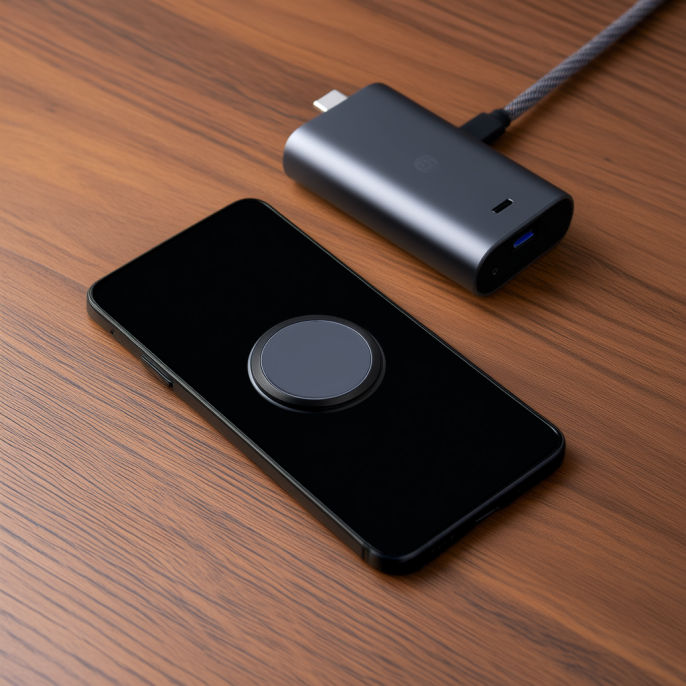
25W is the key to this convergence. Qi2.2 raised the magnetic wireless charging ceiling from 15W to 25W, roughly a 67% speed gain that puts it on par with wired 25W fast charging. The magnetic zone on CUKTECH's unit uses MPP25 and can tilt to about 60 degrees as a stand, sliding neatly into iPhone's Standby mode. In other words, wireless charging used to be best for overnight top-ups; at 25W it now handles daily quick boosts — which is why more 3-in-1 wireless chargers and desktop hubs dare to treat wireless charging as a primary feature rather than a token extra.
There is a real catch here that buyers of these products cannot ignore: China-region iPhones are still capped at 15W. The reason is not a missing certification, but the fact that Qi2's MPP magnetic profile runs at 360kHz, a frequency outside the bands allowed by China's Radio Regulation for Wireless Power Transfer Equipment (100–148.5kHz, 6765–6795kHz, 13553–13567kHz). The result is that mainland iPhone 16 and 17 models are officially rated for 15W over MagSafe / Qi2, while US and Hong Kong versions reach 20W or even 25W. The same TA1406U likely ships with different firmware by region: Qi 25W open overseas, magnetic fast charging disabled domestically in favor of standard Qi. WPC certification covers compatibility and safety; selling in China still has to clear frequency and electrical-safety rules.
For both makers and buyers, this convergence raises the bar. Upstream, folding 25W magnetic wireless charging into a desktop hub pushes design, customization, production, and sales to keep pace: capacity and cost for core parts like magnetic coils, controller chips, and N52 magnets are improving. When shopping for a multi-device or 3-in-1 wireless charger, don't just stare at the wattage on the box — check the WPC database to confirm the certification ID is truly MPP25, then look at the bundled adapter: 25W magnetic charging usually needs a 45W-plus PD brick to hit full speed, and a 20W brick will fall back to around 15W.
Zooming out, desktop stations absorbing 25W magnetic wireless charging shows that wireless charging is shifting from a standalone accessory into a built-in capability. Wireless charging in furniture and public spaces, on desks, and by the bed is quietly disappearing into daily use — you drop a device down and it tops up without hunting for a cable. The next step is Qi 50W: WPC's off-cycle meeting in Beijing this June already moved it into the standards draft, with commercialization expected around 2028. Whether that pulls this wired-wireless merger up another notch remains to be seen, but the boundary of desktop power will likely be blurrier than it is today.
This article is originally published by Shanwu. Please credit the source when reposting.
Copyright © 2026 Shanwu. All Rights Reserved.