
At the Seoul AI Robot Show in early October, one category of exhibits had nothing to do with phones. Korean company WiPowerOne showed a 1.5 kW wireless charging system aimed at autonomous mobile robots on the factory floor. The company calls the approach in-process charging: instead of stopping work and driving to a charging station, a robot tops up at its work site during the brief waits between tasks. By its account that keeps downtime to a minimum and lets unmanned production lines genuinely run around the clock.
Moving charging from consumer gadgets to the shop floor has a hard rationale. Conventional contact charging relies on metal electrodes meeting, which corrode and wear in dusty or damp environments, and a high-current connection can arc at the moment it makes or breaks contact—an unacceptable hazard in coal mines or petrochemical plants. Wireless charging moves energy through electromagnetic coupling with no exposed contacts, which lines up exactly with two requirements: unattended operation and harsh conditions. That is also why industrial wireless charging is not chasing the ease of a casual drop-and-charge; it is chasing years of trouble-free operation with nobody watching.
On the Chinese side, Luyu Energy in Qingdao Hi-tech Zone is a telling example. Founder Li Dan's team started in wireless charging for phones and other consumer electronics, and quickly hit a ceiling: consumer gear typically runs at 5 or 10 W, the technical bar is low, and a crowd of manufacturers fights on price using a mature supply chain. Around 2019 the team switched to high-power industrial wireless charging for mobile robots. Industrial requirements are a different animal: positional tolerance has to reach several centimeters, sometimes more than ten, and power spans from a few hundred watts to several kilowatts. The team settled on a resonant topology—since load and distance shifts knock the resonance point off, algorithm-driven dynamic control is unavoidable, and the difficulty sits well above consumer-grade work.
The most visible change across product generations is size. For the same 1 kW device, the first-generation spec was 300 by 300 mm; the second shrank to 160 by 140 mm, a sharp drop in volume—in Li Dan's words, "the first generation was four times the size of what we have now." The pressure comes from downstream: mobile robots keep getting thinner, and many chassis are under 20 cm deep, leaving no room for a bulky charging module. Shrinking demands reworked circuit topology and high-frequency control, plus solving heat dissipation in a cramped space. Integration is another hurdle—once the transmitter and receiver each became a single unit instead of separate boards, high-power transfer began interfering with internal communication signals, and the team had to combine electromagnetic shielding, circuit design, and control algorithms to push the interference down.
The company's products now cover a few hundred watts up to 6 kW, with a theoretical path to tens of kilowatts, which it says covers 70 to 80 percent of mobile-robot applications on the market. Within that, explosion-proof models built for coal mines and chemical plants have been in mass production for five or six years, an outdoor line adds water resistance, and underwater wireless charging for uncrewed submersibles is still in research. For drones, the team spent two to three years developing a non-planar magnetic coupling coil that halves weight at the same power, and it has entered commercial talks. Its partner list runs past 300 companies, including mobile-robot makers Hikvision, Siasun, and Unitree. The go-to-market model deserves a separate mention: retrofitting robots already in the field is hard, so they pursue design-in, embedding the receiver module during the robot's own development—and because industrial components typically need six months to a year of stability validation, volume cannot ramp quickly. Li Dan is blunt about the field: only a handful of companies in China can build high-power industrial wireless charging reliably.
WiPowerOne in Seoul is on the same path with a longer track record. It built up experience in EV charging first: in 2019 it installed a 60-meter wireless charging road at Dubai Silicon Oasis for electric taxis and buses, and since 2021 a 150 kW wireless charging electric bus has run commercially in Daejeon for five years, while 50 kW systems serve 15 delivery trucks at a logistics center. Moving into robotics, it completed an autonomous mobile robot charging demonstration with Rainbow Robotics, signed a memorandum of understanding, and is now developing wireless charging for humanoid robots, with a plan to build a mass-production platform in 2027. Two figures it keeps stressing are misalignment and air-gap tolerance—industrial sites cannot guarantee precise positioning every time, so staying stable when a robot parks a few centimeters off is the real selling point.
As power climbs, materials become unavoidable. In research published in early October, the Dongguan Institute of Materials Science and Technology of the Chinese Academy of Sciences led a team with the CAS Institute of Physics, City University of Hong Kong, and the University of Cambridge to replace conventional ferrite cores with stress-annealed iron-based nanocrystalline alloy. Ferrite is fine at low power, but as power rises, eddy-current and hysteresis losses grow, cores get hot, efficiency slides, and size cannot come down. Using stress annealing plus coil-aligned lamination, the team produced a magnetic core strip just 440 by 330 mm and 4 mm thick—roughly half the profile of a standard ferrite plate—with core loss down to 135 kW per cubic meter at 85 kHz and 0.2 T. The 20 kW-class system reached 98.51 percent AC-to-AC efficiency and a volumetric power density of 9.55 kW per liter, with the study published in Nature Communications this month. The team explicitly points beyond passenger cars to AGVs in factories and warehouses, heavy rail transit, and low-altitude electric aircraft such as drones.
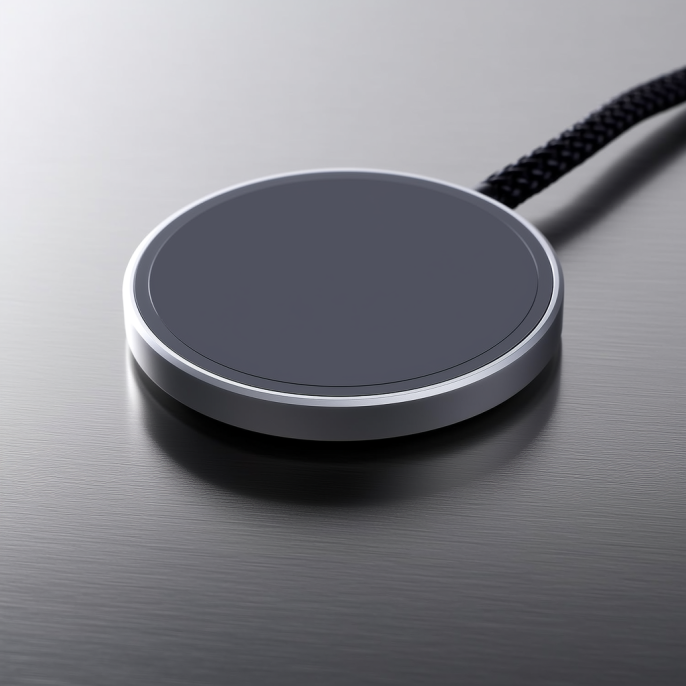
Taken together, these threads show wireless charging splitting into two lines. On the consumer side, Qi2 25W magnetic pads compete on who runs cooler, charges faster, and costs less. On the industrial side, the contest is high power, wide misalignment tolerance, rugged environments—and whether you can get designed in at the robot's development stage and show up on site when something goes wrong. Li Dan's read on passenger EVs is worth keeping: large-scale adoption is unlikely soon, and the blocker is not technology but ecosystem—an open setting needs a unified standard and has to get past infrastructure spending and automakers' cost bargaining. What he does expect to grow is driverless vehicles, drones, and quadruped robots, which he calls the focus for the next three to five years. For anyone building wireless power products, the industry's boundaries have kept expanding: from the phone desk, to homes and public spaces, and now to the shop floor and the warehouse. Product definitions shift with it—power, misalignment tolerance, ingress protection, and communication protocols are now debated earlier than the industrial design.
This article is originally published by Shanwu. Please credit the source when reposting.
Copyright © 2026 Shanwu. All Rights Reserved.