
The short answer: a compliant wireless charger does keep drawing a trickle of power while plugged in with no phone on it, but the amount is small enough to ignore. The real energy hogs are cheap pads that skip standby optimization. I used to assume no phone means no power, until a power meter showed a no-name pad sitting at 1.8 W idle — that's over a dozen kWh a year, enough to charge my phone hundreds of times over.
Why does an empty pad still use power? Wireless charging runs on electromagnetic induction, and the transmitter coil has to keep emitting a 100–200 kHz field just to ping for a phone. That sensing circuit can't be removed, so the Qi spec caps transmitter no-load draw at 0.5 W. Well-designed units push it down to around 0.1 W — Apple's MagSafe puck, for example, sits right at that floor.
Charging efficiency is a separate story. Induction always loses some energy, and a Qi v1.2.4 pad delivers roughly 70% of its draw into the battery, with Qi2 nudging that to about 73%. Charging a 5000 mAh phone from 20% to 80% daily, the wireless overhead versus wired adds up to only a couple of kWh a year — a few cents. Hardly worth losing sleep over.
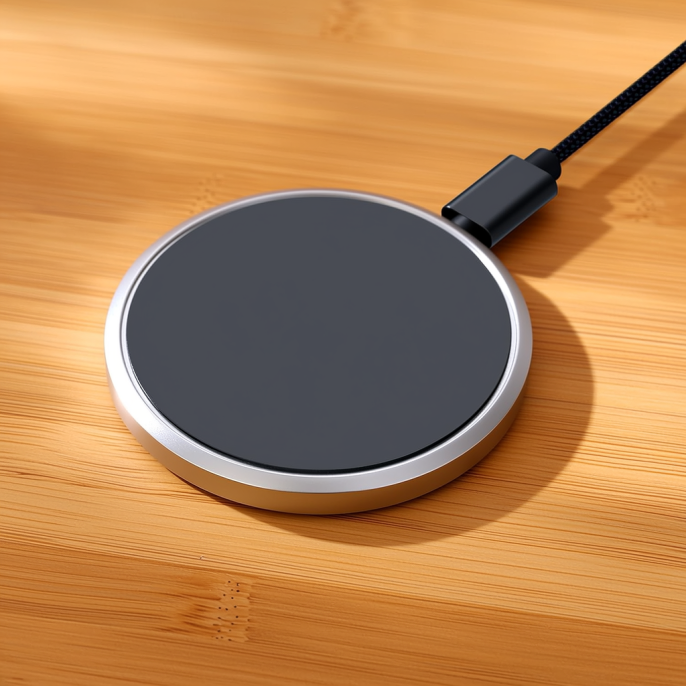
The gap explodes at idle. One set of tests put an uncertified pad at 2.9 W idle, about 12 dollars a year, against a proper Qi2 pad at 0.4 W, roughly 1.77 dollars a year. Over three years that 32-dollar difference alone covers the price of a decent charger — so a cheap pad quietly bills you back the savings you thought you were making.
Alignment is another overlooked variable. Shift the coils more than about 2 mm and the transmitter pushes harder to hold the field, dragging idle draw from 0.1 W up to 0.3 W even when nothing is charging. I now wait for the magnetic click to confirm it's seated instead of tossing the phone down — a small habit that adds up.
Regulation keeps pushing standby lower. The EU's ERP directive already caps wireless-charger no-load draw at 0.5 W, and the late-2025 update tightens single-voltage adapters to 0.075 W. On the China side, 3C together with FCC and CE marks usually means the standby figure is documented on the label or in the manual — one glance tells you if a pad is frugal.
So should you unplug daily? My rule: the nightstand pad I use every day stays put — a year of idle costs a buck or two, not worth the bend. But the study outlet I touch once a week gets unplugged on the way out. The bigger win is simply skipping no-name pads that don't even list standby power — that's the real, silent, ongoing energy leak.
Three things to check when buying: look for a real Qi or Qi2 certification number rather than a vague compatible claim, read the label for a stated standby figure, and prefer low-power models carrying CCC, CE or FCC marks. Magnetic wireless chargers and magnetic power banks sit by your bed far more often than you think, so this is exactly where frugal, certified choices pay off.
This article is originally published by Shanwu. Please credit the source when reposting.
Copyright © 2026 Shanwu. All Rights Reserved.