
Walk into any café, hotel lobby or airport lounge and you will likely find a wireless charging pad built into the table, used by whoever walks past. It is even more public than a shared power bank — nobody rents or returns it, yet dozens of hands and phones touch it every day. The moment it hit me was watching a neighbour rest a phone on the pad right after holding a subway handrail, then pick it up to scroll. Nobody wipes these pads, and operators avoid it too, fearing liquid in the seams or damaged coils.
The numbers are not scary on their face but they are real. Shenyang's health commission has flagged the hygiene gap in shared items like public power banks: touched by dozens or even hundreds of people a day, with no practical way to disinfect between users, and surfaces hosting Staphylococcus aureus, E. coli, norovirus, influenza and mould that survive for hours to days. A lab test by a People's Daily-affiliated team measured the outer surfaces of three shared power banks at about 216,000 CFU/㎡ (Jiedian), 440,000 CFU/㎡ (Xiaodian) and 8,000 CFU/㎡ (Monster), against roughly 80,000 CFU/㎡ for a typical toilet seat. A public object nobody wipes really can carry more bacteria than a toilet.
The real risk is not the charging itself but cross-contamination. Your phone's back rests on the pad, which already carries the previous user's sweat, oil and microbes; the instant you pick it up, your fingers go to the screen, your eyes or your snack. That chain — pad to phone back to your hand to your mouth and nose — is far more dangerous than the wireless field. People who lay the phone face-down are pressing the dirtiest surface onto the pad and carrying it home.
Your phone is already a mobile germ station. Repeated microbiology studies confirm that smartphones often carry several times the colony count per cm² of a toilet seat, because we touch them dozens of times a day and usually while eating. Put that dirty phone on a public pad and the pad gets dirty too; the next user adds another layer. A public wireless charger quietly becomes an invisible transfer point for bacteria.
If you are the owner of that pad — say a café, front desk or club that installed its own public wireless charger — clean it the right way, not by dousing it in alcohol. Apple's official cleaning guide is clear: hard, non-porous surfaces can be wiped with a 70% isopropyl alcohol wipe or a Clorox disinfecting wipe; skip bleach and never pour liquid onto the device. Most pads are matte plastic or silicone; the odd alcohol wipe is fine, but daily spraying eats the coating and makes silicone sticky. The safer routine is to unplug, wipe gently in one direction with a lightly damp microfiber cloth, avoid the indicator LED and seams, then let it dry before powering on.
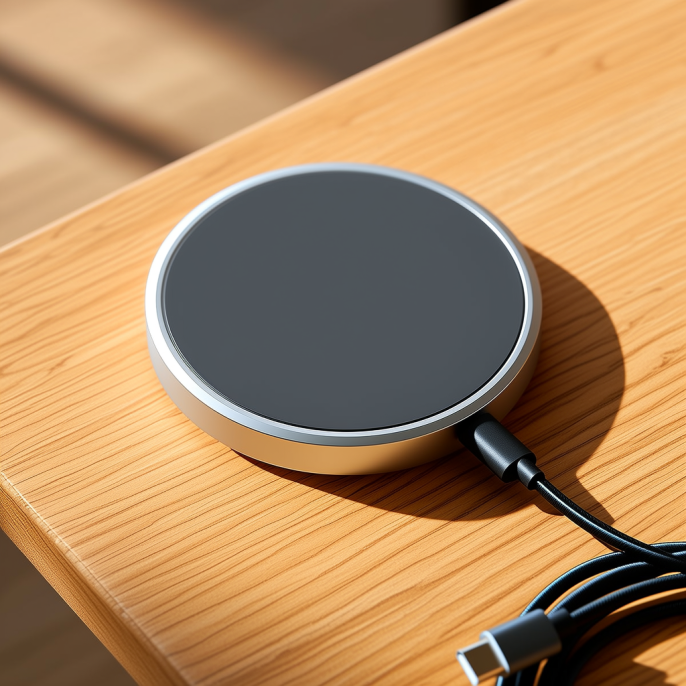
As a user, three moves cover most of the risk. First, before you place the phone, wipe its back with an alcohol pad and give the pad a quick wipe too — many airports and cafés now leave disinfecting wipes right next to the pad, so use them. Second, once charging finishes, don't grab food or rub your eyes with that hand; hit the hand sanitiser first. Third, at home wipe the phone back again, especially the fingerprint reader and the camera ring. I keep a small pack of alcohol pads in my bag and wipe before using any public pad; it costs pennies and buys a whole day of peace of mind.
A few traps to avoid. Don't cover the pad with a wet wipe while charging — liquid in the seam can short it or corrode contacts, exactly what operators worry about. Don't lay plastic wrap or a sticky note on the pad to keep it clean; that blocks the coil, stops charging or overheats. And don't eat while charging, moving your hands between pad, phone and food, which feeds bacteria straight into your mouth. If you rely on magnetic wireless charging, carry a small magnetic puck and lay it on the public pad first, then your phone on top — it aligns and adds a clean barrier in one move.
At bottom, a public wireless charger is a convenience, not a problem; the only issue is that nobody manages hygiene. Operators adding it to the daily cleaning list and users spending ten seconds before and after easily dissolves the worry. For teams designing and producing public wireless chargers, a wipe-friendly matte surface, a seamless flat top, and a small 'please disinfect before use' note at the edge are details that look good and stay easy to maintain. Wireless charging is meant to save us worry; on hygiene, a little of our own attention goes a long way.
This article is originally published by Shanwu. Please credit the source when reposting.
Copyright © 2026 Shanwu. All Rights Reserved.