
The iPhone 18 Pro and Pro Max went on sale on 18 September. The most tangible upgrade this generation sits in charging: pair either phone with a 60W-or-higher adapter and cable that support Adjustable Voltage Supply under USB Power Delivery 3.1, and you go from 0 to 50 percent in roughly 15 minutes, about twice as fast as the previous generation. Wireless did not double along with it. MagSafe and Qi2 stay at 25W, and with a 35W-or-higher adapter you reach 50 percent in around half an hour. Wired wins on time, wireless wins on convenience, and this generation draws that line clearly.
What anyone building chargers should really watch is Apple's first foldable, the iPhone 18 Ultra Foldable. Folded, it behaves like any other iPhone: a magnetic ring on the outer back panel delivers the full 25W of Qi2.2. Unfolded, the surface facing down becomes the inner foldable display, which is not a coil-friendly surface, so the rate falls straight back to the 5W basic profile. In practice you charge this phone closed, and Apple's own magnetic pads are designed around that.
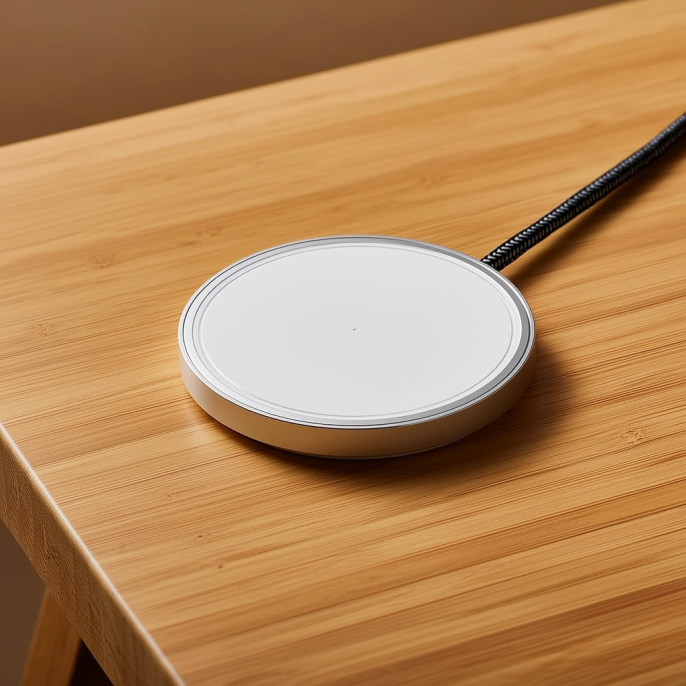
The significance goes beyond a few watts. A foldable is the first form factor to put wireless charging's oldest physical constraint on the table: the coil has to sit directly against a metal or glass back, with no deforming display in between. The unfolded state is thinner and has a hinge running down the middle, which makes both coil placement and heat dissipation awkward. The drop is a design trade-off, not a tuning problem.
Alignment is stricter on a foldable than on a slab phone. The magnetic ring has to sit over that specific model's coil, which is why cross-brand magnetic cases generally fail here: a Galaxy Z Fold 8 needs a Samsung-specific case that places the ring where the foldable's coil actually sits. Fit a different case and the alignment is off, so 25W never happens. Accessory makers and custom-case shops have to work model by model; a one-size-fits-all shell simply stops working on a foldable.
One easily missed trap: compatible with Qi2 and Qi2 certified are not the same claim. A compatible pad may carry only basic-profile hardware inside, so the phone still caps at 5W, the same treatment the foldable gets when it is open. The safe route is to look for WPC's Qi2.2 certification mark, or buy from brands willing to publish their certification number, then confirm the real wattage with a tester at home.
Temperature deserves a note too. The Pro Max has a larger chassis and exclusive camera hardware that draws more under load, so its back glass reaches the 40°C ceiling a little sooner than the Pro's. By spec the sustained rate is identical on both; what differs is how quickly throttling starts, and that gap is measured in minutes, not watts. For manufacturers the takeaway is clean: under a 25W ceiling, cooling and thermal management decide the outcome, not the number printed on the box.
The wired side has knock-on effects as well. 60W is not simply a bigger adapter; it requires both the adapter and the cable to support Adjustable Voltage Supply under USB Power Delivery 3.1, and the box ships with only a one-metre USB-C cable, so the wall adapter is on you. A desk setup therefore shifts from one high-wattage brick feeding everything to a pair: a wireless dock plus an AVS-capable adapter. That makes the case for a multi-device wireless charging station clearer rather than weaker.
A final caveat: as of mid-September, Apple's current lineup still does not include a standard iPhone 18, so carrying the Pro's 60W wired and 25W wireless figures over to an unannounced model is not sound. Building wireless charging for a foldable also means following the form factor: compete on alignment precision and cooling when it is closed, and let wired charging or a dock cover the open state. 25W has been stable for two years; from here, the edge belongs to whoever nails the details.
This article is originally published by Shanwu. Please credit the source when reposting.
Copyright © 2026 Shanwu. All Rights Reserved.