
September turned out to be a busy month for charging accessories. In September 2026 ESR introduced three new chargers in Japan at once, and the through-line is clear: push the everyday experience of wireless charging one step further. The headline product is the ESR Cyclone 25W magnetic charging pad, which packs active cooling and a 0–150° adjustable stand into a palm-sized disc. That signals the 25W magnetic wireless charging race has quietly shifted from 'can it actually hit 25W' to 'is it pleasant to live with once the phone is on it.'
Start with the Cyclone. It follows the Qi2 25W magnetic path with a 25W peak wireless output and ESR's own CryoBoost active cooling on top. The claimed figures: active cooling lowers the phone's charging temperature by up to about 6.5°C, and with that setup an iPhone 17 Pro reaches 50% in roughly 26 minutes. Fitting a fan and an airflow channel into a small disc is really about the old 25W headache — the hotter it gets, the more it throttles. That is exactly the problem high-end magnetic wireless chargers have kept circling this year.
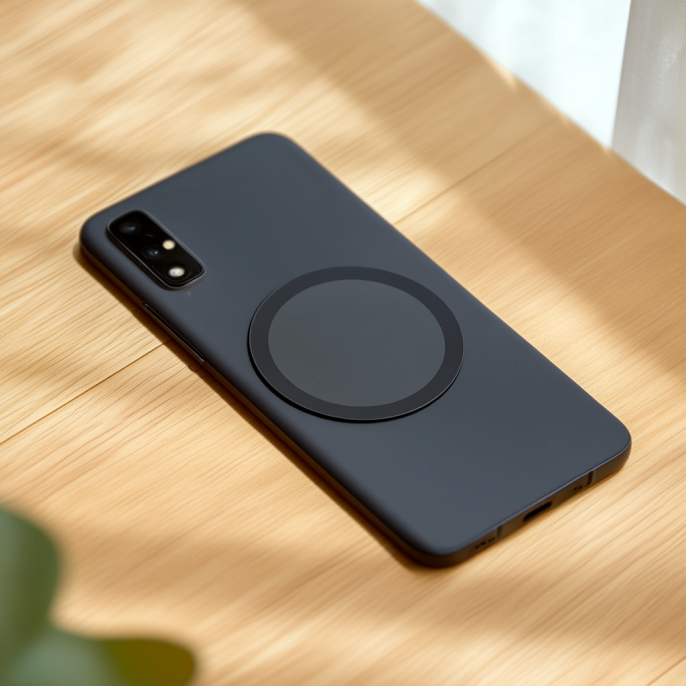
The stand is another upgrade people tend to overlook. The Cyclone ships with a hinge you can set anywhere from 0 to 150 degrees, so the phone works standing up or lying down — watching video, taking a call, or glancing at messages without taking it off the pad. Until now that kind of flexibility mostly lived in dedicated upright wireless chargers; dropping it into a magnetic disc shows that 'charge while you use it, and keep the screen in view' is moving from nice-to-have to baseline. ESR also quotes hold force: up to about 2000g through a magnetic case, about 1200g bare, so it stays put once placed.
The other two in the batch read more like clearing up the mess at the power-source end. The ESR Xtend 45W retractable charger and the Xtend 100W in-car retractable charger both build a spring-back USB-C cable into the body. The thing people hate most on a desk or in a car is usually not the charger itself but the cable that never stays tidy. No matter how convenient a magnetic wireless charger is, it still needs a cable running from a wall adapter; tucking that cable into the body straightens out the whole 'wireless pad plus its power feed' chain.
Read together, these releases trace a fairly clear industry line: once 25W magnetic wireless charging was rolled out fast through WPC certification and chips and modules knocked the barrier down, accessory makers' battleground for differentiation moved off the wattage number and onto experience details — structure, thermal management, and certification. Belkin's two-in-one foldable magnetic charger that hit Chinese shelves on September 13 (iPhone 25W plus AirPods 5W, ¥429, with its own ChillBoost cooling) runs on the same logic: everyone is now selling 'easy to use.' For factories doing design, customization, production, and sales, that means tooling, thermal structure, and certification capability open a wider gap than simply chasing higher watts.
For everyday users, this round of one-upmanship is good news. Two years ago, a magnetic wireless charger that held 15W was already decent; now 25W is the baseline and brands are competing on who runs cooler, who holds steadier, and whose cable is less of a chore. You no longer need to parse a wall of inflated specs — look for Qi2 25W certification, check the cooling method and the stand angle, and you will mostly avoid a bad buy. The day wireless charging truly goes mainstream probably will not come from doubling the power again; it will come when most people have stopped thinking about 'where do I plug the cable in' at all.
This article is originally published by Shanwu. Please credit the source when reposting.
Copyright © 2026 Shanwu. All Rights Reserved.