
On September 14 at IAA Transportation 2026 in Hannover, Israeli firm Electreon showed off a deceptively plain charging pad laid into a parking space. Called Lite DOT, it delivers up to 11 kW, needs no excavation to install, and starts charging the moment a compatible vehicle parks over it — no plug, no cable, just walk away.
The concept is simple: a transmitter pad on the ground, a receiver under the vehicle, and charging begins automatically once the car is parked in position. In Electreon's setup the pad sits above an existing parking space, the control unit mounts on a garage wall or an outdoor pole, and a smartphone app handles identification and scheduling. The company says it runs reliably in rain and snow and across a -30°C to +50°C range, covering the harsh conditions of outdoor lots.
Why now? Electric vehicle registrations in Europe rose more than 30 percent in the first half of 2026, and the IEA estimates around 40 percent of global new car sales could be electric by 2030, requiring roughly 150 million more charging points by decade's end. The weak link in wired charging is the cable itself — constant plugging, weather exposure, and being run over by vehicles. Burying charging in the parking space deletes the find-a-post, plug-in, unplug routine, which pays off most for fleets that simply charge while parked.
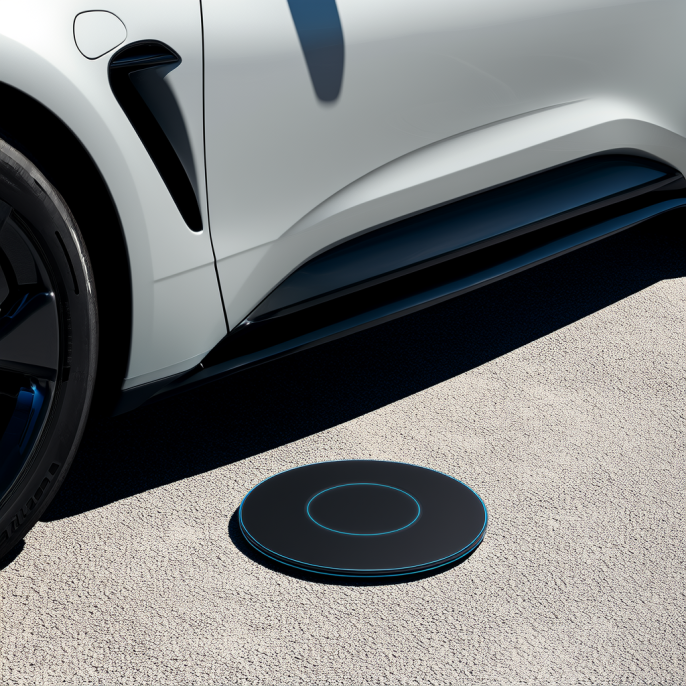
Electreon is hardly new to this. Its portfolio already spans LINE (charging in motion), DASH (opportunity charging), and DOT (charging while idle); Lite DOT is the first time it packages stationary wireless charging as a modular setup that drops into a normal space without civil works. CEO Oren Ezer put it bluntly: the future of electric mobility is wireless and will soon be in every parking space. Bold, but the interest from automakers and suppliers suggests the industry is taking the next stage seriously.
For the wireless-charging world, this is bigger than just another use case. It pushes the technology out of phone desks and cafe counters into parking lots and fleet depots — the kind of public-space wireless charging that scales from palm-sized gadgets to ton-scale vehicles. Whether the alignment, thermal, and foreign-object-detection know-how built up in consumer electronics can carry over to tens-of-kilowatts automotive grades is the most interesting engineering shift to watch.
Real deployment will take time, of course. Lite DOT still needs a vehicle-specific receiver from automakers, so model coverage is thin for now; cost, interoperability, and service liability — familiar headaches — get magnified several times in automotive grades. But the direction is clear: once charging becomes something that just happens while you park, the business is no longer about selling a pad but about selling a whole production-and-deployment stack, which is exactly the design, customization, manufacturing and sales playbook domestic supply chains know best.
This article is originally published by Shanwu. Please credit the source when reposting.
Copyright © 2026 Shanwu. All Rights Reserved.