
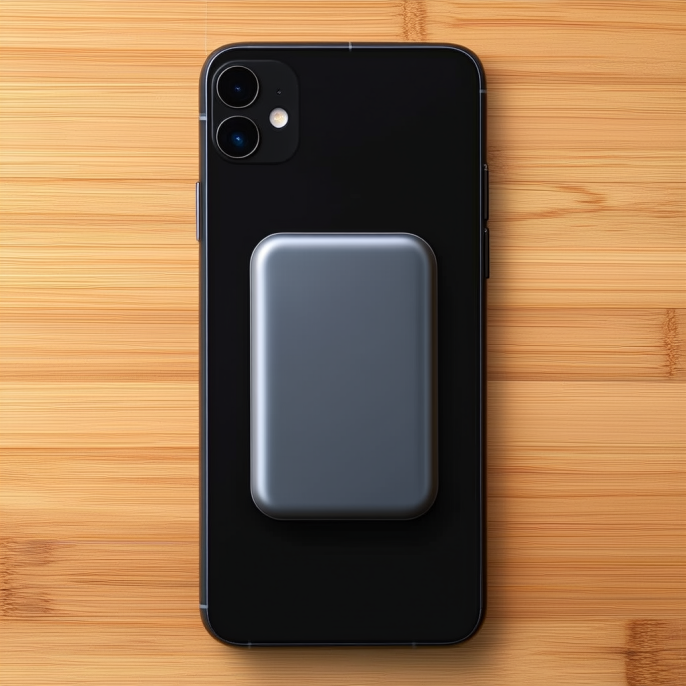
On September 12, MOMAX launched a magnetic power bank called the Q.Pass X. At 298 yuan it is card-sized, just 8.3 mm thick and 125 g, with 18 N52 neodymium magnets embedded on the back to hold a phone in place. The specs are modest: 5,000 mAh, 15 W wireless output, and only 7.5 W for iPhones. What actually stands out is the companion Recharge Hub app. Once connected, you can read the bank's remaining charge, battery temperature, charge cycles, port power, and even cell voltage and current. A power bank is starting to show its own vital signs to the user.
The context matters more than the product. On March 31 this year, GB 47372-2026, the Safety Technical Specification for Power Banks, was published, and it takes effect on April 1 next year. For the first time the standard makes intelligent management a mandatory requirement. A power bank must monitor cell voltage and charge or discharge power in real time, log abnormal events such as overcharge and overheating together with their timestamps, and let the user read the model, a traceability code, and the abnormal-event records. In the past, a fault was something the user had to guess at; now the regulator expects the device itself to keep the ledger.
The standard also redraws several critical design lines. It calls for secondary lithium protection: if the first layer fails, a second must still stop the risk. After a certain number of cycles the device must be force-derated rather than keep running at full power, and on a severe under- or over-voltage event it is permanently disabled from charging. For a magnetic wireless power bank that crams a coil, a battery, and fast-charge circuitry into a few millimeters, the board is already tight, and now more protection and management logic has to fit in, pushing upstream suppliers toward far more integrated chips.
Chip makers are already moving. At the 2026 World Wireless Charging Conference, hosted online by ChargePal (chongdiantou.com) on August 20, solution providers such as ZhuoXinWei showed four-in-one controllers built for the new standard. The CPW3211, for example, packs PD and QC fast-charge protocols, 15 W EPP wireless control, USB smart interaction, and secondary lithium protection into a single main controller, using USB communication to deliver the standard's readable-data requirement. From silicon to finished product, the whole chain is being re-arranged around the word traceable.
From the user's side, the change is concrete. In the past, when a magnetic power bank swelled, ran hot, or refused to charge, you could only guess from feel and luck whether it was still safe to use. After the new standard lands, more products like the Q.Pass X with app-readable data will appear, and you will be able to see at a tap whether the battery runs hot, how many cycles it has done, and whether any overcharge was logged. The regulator has turned battery health from an internal factory parameter into a consumer's right to know.
For manufacturers handling design, customization, production, and sales, this trend is also a watershed. The new standard does not nudge the bar up slightly; it turns checkable safety into a required box every unit must tick before leaving the factory. Whoever first turns secondary lithium protection, smart management, and a traceability interface into a stable mass-production solution will trip fewer hazards in the market after next April. Magnetic wireless power banks have moved from just charge it to explain what is wrong with itself, and the regulator, alongside a few vendors willing to move first, has pushed the industry across that line.
This article is originally published by Shanwu. Please credit the source when reposting.
Copyright © 2026 Shanwu. All Rights Reserved.