
Many shoppers treat a 'magnetic mount' and a 'magnetic wireless charger' as the same thing, assuming anything magnetic will also charge the phone while navigating. In reality, a plain magnetic mount only uses a ring of magnets to hold the phone on a vent or dashboard and contains no charging coil at all; a magnetic wireless charger hides a full coil and circuit board behind the magnets, so it powers the phone as it holds it. The first question to answer before buying is whether you need a holder or a charger—get that wrong and you pay for the wrong product.
Open both up and the difference is obvious. A plain magnetic mount is mechanically simple: an N52 neodymium magnet array plus a thin metal plate you stick on the phone or case, with zero electronics, which is why it rarely fails mechanically. A magnetic wireless charger adds the costly parts: a transmitting coil wound from litz wire, a resonant capacitor, a control chip, and a ferrite shielding sheet that directs the field toward the phone back. Both share the word 'magnetic,' but one hides a complete wireless charging module inside, and it shows in the extra weight and thickness.
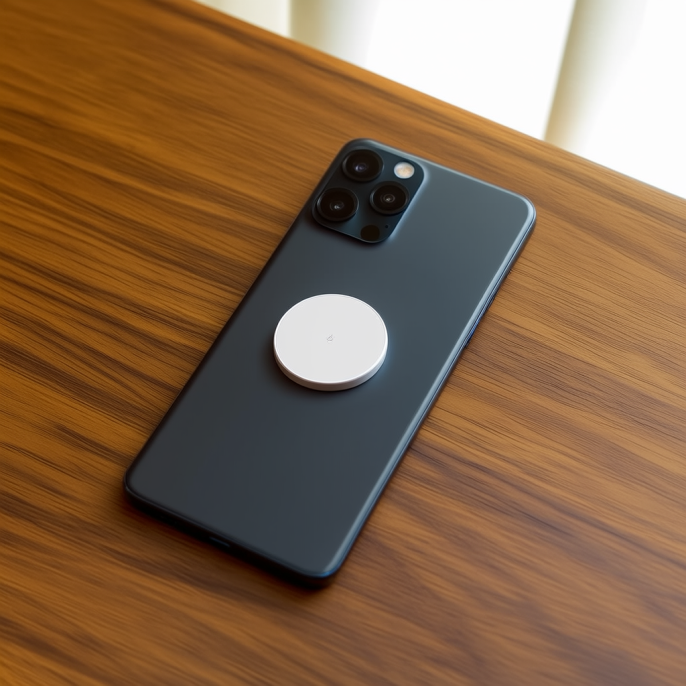
The cost shows up in the price. A buyer's guide on 1688 puts it plainly: because a wireless-charging mount has a built-in coil and circuit board, its unit price is typically 10 to 20 yuan higher than a plain magnetic mount; at wholesale volume, the charging version runs about 8 to 15 US dollars per unit (500-unit minimum) versus just 2 to 5 dollars for a non-charging mount. That gap is not brand markup—it is the real cost of the coil, chip, and certification. Don't pay the premium just for the word 'magnetic' if you will never use the charging part.
Charging capability is the real dividing line. A magnetic wireless charger typically outputs 15W, and Qi2-certified models already reach 25W, provided you pair it with a 20W-plus PD car adapter or charger. A plain magnetic mount stays at 0W no matter how you power it—the phone still drains, losing charge just as fast during an hour of navigation. If your whole reason for buying it is to top up the battery while driving, you need the version with the coil; a holder alone will not solve a low-battery day.
A plain magnetic mount has one unavoidable trap: it requires a metal plate stuck on the phone or case, and that plate often sits right over the wireless charging coil, blocking the charging signal, interfering with NFC and Apple Pay, and making the phone run hot. The clever part of MagSafe and Qi2 is that the magnet ring is built into the phone back and aligned precisely with the coil, so charging passes straight through the mount without any extra plate. If your phone already supports magnetic charging, skip the metal plate—otherwise you lose both the secure hold and the charging.
Certification thresholds differ too. A product that transmits wireless power needs Qi, FCC, and CE marks for overseas markets and 3C for China; a plain mount emits no radio energy, so its certification is far simpler. That is why, when choosing a magnetic wireless charger, spotting the Qi2 or Qi logo matters more than trusting the wattage printed on the box—uncertified products often overstate their power and slowly cook the battery through poor cooling. For bulk buyers and public-space deployments, writing 'WPC certification plus test report' into the acceptance checklist is the baseline.
Interestingly, on pure holding force the plain mount actually wins by a hair. With no coil gap to bridge, its magnet array sits closer to the phone. In BWOO's tests, the non-charging mount pulled over 1,500gf while the magnetic wireless charger reached about 1,200gf. The gap is small, but it makes a point: if all you want is a rock-solid hold and no charging at all, the plain mount grips harder; if you want charging, accept slightly lower but perfectly adequate force in exchange for power-while-mounted.
The choice comes down to one question. If your phone supports magnetic charging—iPhone 12 and later, or an Android with a magnetic case—and you want power while mounted, go straight for a Qi2 magnetic wireless charger. If you only need to fix the phone at the navigation spot and will charge by cable, a plain magnetic mount is cheaper, lighter, and grips harder. For rental cars, multi-vehicle households, or quick temporary use, the cable-free mount that installs in thirty seconds is the easiest call. Decide whether you need charging first, and you will usually spend less than buying both.
This article is originally published by Shanwu. Please credit the source when reposting.
Copyright © 2026 Shanwu. All Rights Reserved.