
On September 11, the autumn edition of the Asia Charging Expo (ACE 2026) opened at the Qianhai International Conference Center in Shenzhen, hosted by Chongdiantou. At a show like this, most eyes go straight to the finished gear—which new magnetic wireless charger or three-in-one wireless charger looks the sleekest. This year felt different. A quieter corner of the hall was worth stopping at: the controller (chip) zone pulled in close to forty semiconductor companies, and within it names such as Fudan Microelectronics, Ziguang Tongxin, Maxic, Injoinic, NuVolta and ConvenientPower clustered around wireless-charging silicon. The signal is getting hard to ignore: the real contest between wireless chargers is quietly shifting from the shell of the pad into the chip sitting inside it.
The Qi2.2 standard and 25W MPP, which have pushed power levels up over the past couple of years, have raised the bar for the silicon itself. A single controller used to be enough if it just handled power transfer; now one chip has to juggle protocol communication, power regulation, foreign-object detection, temperature monitoring and safety protection all at once, and both control precision and system integration have to keep pace. The industry's answer is to move toward highly integrated SoCs—folding the main controller, the driver, the protocol stack and part of the detection logic into a single chip, which trims the surrounding components and the PCB footprint. For anyone building magnetic wireless chargers or multi-device wireless chargers, that matters in a practical way: a smaller chip with fewer external parts is what lets a product get thinner, run cooler, and fit into a tight body.
You can see plenty of these one-chip-does-the-job examples in actual products. Southchip's SC96019, for instance, is a wireless-charging SoC built for Qi2.2 in a package just 4 by 4 millimeters, supporting up to 25W under the WPC 2.2 spec, with a low-resistance full-bridge power MOSFET built in, plus Q-factor foreign-object detection and a full set of under-voltage, over-voltage, over-current and over-temperature protections. In other words, a transmitter that once took several chips and a pile of external parts to assemble is now largely swallowed into one die. Heat and size—the two chronic headaches of magnetic wireless charging—start getting reworked right at the chip level.
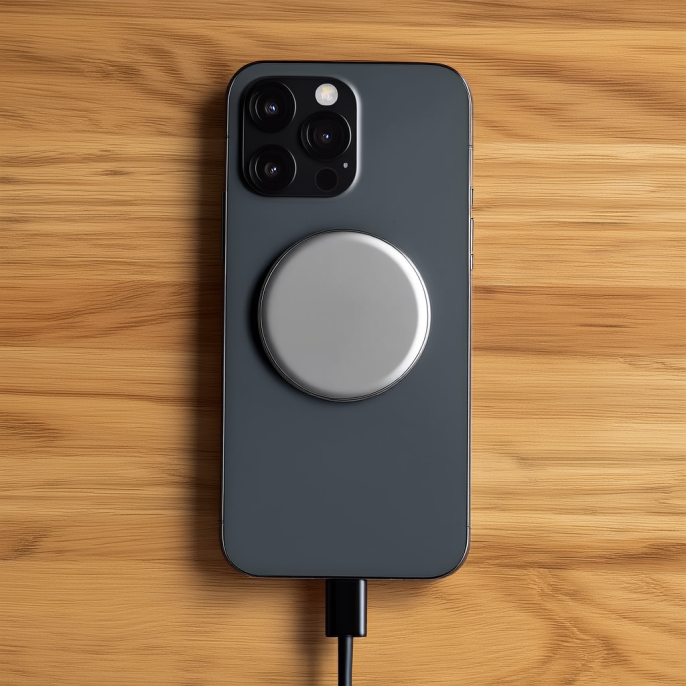
Magnetic wireless power banks were the other main thread in the chip zone. They are far more complex than an ordinary wireless charger—on top of wireless transmission, they have to manage battery charging and discharging, USB-C fast charging, buck-boost conversion and whole-device power allocation, so the silicon is growing from pure transmit control toward a blend of wireless charging, fast-charge protocols and battery management. Zhuoxinwei's approach is telling: a single CPW3211 four-in-one IC packs PD, QC and other fast-charge protocols, EPP wireless-charge control, secondary lithium protection and smart USB interaction together, while the overseas Qi2.2 25W tier adds an SC96019 dedicated to the wireless side. There is also a push behind all this—the new national power-bank standard GB 47372—2026, released at the end of March 2026 and taking effect in April 2027, which writes battery safety, status monitoring, and information logging and readout into its requirements, forcing chips to shoulder more safety and data-exchange work.
One piece that used to be easy to overlook, and that was pushed into the spotlight this time, is the Qi authentication chip. Companies like Fudan Microelectronics and Ziguang Tongxin showed matching security chips and authentication schemes for device identity and secure communication in wireless-charging gear. This is not optional: in a proper Qi2 system, the charger and the phone shake hands and authenticate before high power is even on the table. So the question a device has to answer has grown from 'can it charge, and how fast' to include 'does it pass authentication, and is the link secure.' ConvenientPower's three-in-one base is a clear case—its CPS8610 SoC handles the 25W wireless output, with a dedicated CPS1010 authentication chip alongside it. Only when the controller, the power devices, the authentication chip and whole-product certification are strung together does the wireless-charging silicon chain feel complete.
Looking at end-product forms, wireless charging is no longer just a pad for phones and earbuds. Magnetic power banks, wearables, the three-in-one wireless chargers on a desk and in-car wireless chargers are all crowding in. Each of those scenarios has its own demands for power, size, thermals and reliability, which forces chip vendors to widen their product lines. One clear direction is 'one chip, many charges'—Injoinic's IP6862 transmitter SoC, for example, tops out at 30W on a single path and can run topologies like 15W+5W or 15W+15W+3W to power several devices at once, with both static and dynamic foreign-object detection built in. A multi-device wireless charger that feeds a phone, a watch and earbuds at the same time increasingly leans on the chip layer to work out how power gets split and how stray metal gets caught.
Put it all together and you can see the center of gravity in wireless charging drifting upstream. As chips grow from single controllers into system-level solutions, the payoff is that they lower the barrier on both design-and-customization and manufacturing-and-sales—a smaller factory holding a highly integrated SoC and a mature reference design can bring magnetic wireless chargers, three-in-one wireless chargers, and even the embedded home-and-public-space wireless charging built into desks, hotels and airports to market faster. But a lower barrier also means everyone's chips start to look alike, and the real gap opens up in the less visible work: structure, thermal design and certification. What is worth remembering about this show is not a few more good-looking chargers—it is that an ever-more-complete chip is quietly deciding how small, how fast and how stable the next generation of wireless charging can be.
This article is originally published by Shanwu. Please credit the source when reposting.
Copyright © 2026 Shanwu. All Rights Reserved.