This week, as iPhone 18 Pro and Pro Max units reach buyers, the loudest argument in Chinese forums isn't about color—it's "how many watts is the China-model wireless charging actually rated for." Apple's US site lists MagSafe at up to 25W, while many China-facing summaries still say "still capped at 15W, no upgrade." Same phone, two spec sheets, conflicting numbers. Accessory makers are already pushing "25W Qi2.2 new arrivals" into view. Before China-model owners pull out their wallets, it's worth sorting out which number actually applies.
Set the boundaries first: there is no hard proof that a China-model phone can never reach 25W, and no official Apple acknowledgement that it reliably does. What we can confirm is that overseas models (US/HK/JP) list MagSafe Qi2.2 at up to 25W, while the China-model wireless rating remains a gray area. Charging-head.com ran a full test in late September using a China-model Pro Max with a Hong Kong MagSafe puck and third-party Qi2.2 chargers, logging a fastest 0–50% in 29 minutes and a full charge near 1.5 hours. In other words, a certified Qi2.2 charger can indeed trigger the 25W tier on a China-model unit.
On the other side, overseas testers like Zeera compare Apple's regional spec sheets line by line and plainly note "the US model lists 25W, the China model lists 15W—that's a device-spec setting, not something a different puck can unlock." A long post on SMZDM similarly advises China-model owners to "make decisions based on 15W," treating it as the guaranteed floor and 25W as an unverified lottery. Who's right? The safer read is that the power ceiling has two layers: a firmware cap baked into the device, and whether the charger and adapter can actually feed it. Which layer the China model is locked at, Apple hasn't said in plain words.
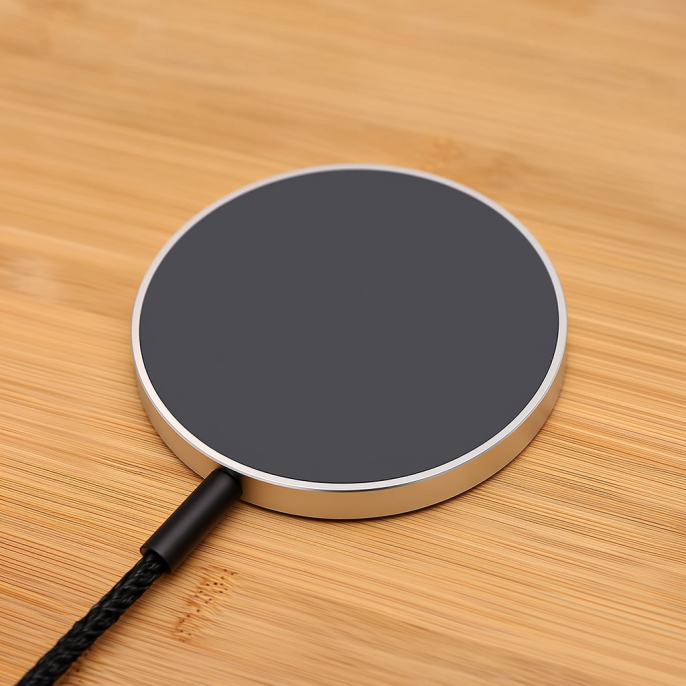
For everyday buyers, arguing over "is it locked or not" matters less than seeing three facts clearly. First, whether China or overseas, hitting 25W requires both a WPC Qi2.2-certified magnetic pad—check the WPC certification number, not just the "up to 25W" on the box, since many "Qi2-compatible" pads are really 5W BPP hardware—and a USB-C adapter rated above 35W. Apple's older MagSafe (model A2140) caps at 15W, so don't grab the wrong one. Second, Charging-head.com also noted that adding semiconductor cooling to the pad visibly improved power stability and shaved a little off total time; at 25W, heat is the other gate that decides whether the speed holds.
The third fact is the one marketing most easily buries: for China-model buyers, a 3C mark matters more than the words "25W." Earlier this month Pisen recalled two power-bank models over fire risk, and power banks without 3C certification can no longer even board domestic flights. Plenty of "25W Qi2.2" magnetic banks on the market are overseas variants that never cleared China's certification—they look tempting, but they'll be stopped at the airport security line. For China-model owners, "can I legally carry this on a plane and safely leave it charging overnight" is far more real than "10W more at peak."
Back to the original worry, the advice for China-model owners isn't complicated: if you already own a MagSafe or a certified Qi2 pad, don't rush to replace it just for "25W." If you do upgrade, look for the WPC Qi2.2 certification number and confirm it's the China-certified, 3C-marked version—not a gray-import overseas unit. Want genuinely faster? The 60W wired path (needs a PD-AVS adapter) hits 50% in 15 minutes. Wireless charging was always meant for the nightstand and desk—the "drop it and forget it" moments—not the minute-by-minute fast-charge race.
What makes this iPhone 18 wireless story more interesting than the spec sheet is that it puts "same model, different regions, mismatched power labels" right in front of buyers. Whether it's 15W or 25W, there's no final answer yet—but there is one line that can't be wrong: don't let any single claim set the pace. Trust certification, trust the 3C mark, trust real tests; that beats staring at one wattage number. Once Apple clarifies the China spec, or more China-model tests settle the question, this debate will close on its own.
This article is originally published by Shanwu. Please credit the source when reposting.
Copyright © 2026 Shanwu. All Rights Reserved.